Guides & Custom20 min read
T-shirt Size Charts: The Guide to Always Getting It Right Online
By
Published on 15 de Jun 2026
It’s happened to all of us. You see the perfect t-shirt online, that Dragon Ball or League of Legends piece that calls out to you, you click “buy” and, when it arrives, the disappointment is total. Either it fits you like a sack or it doesn’t let you breathe. The truth is that it’s not you, it’s the lack of a standard in size charts. An ‘M’ in one store can be an ‘L’ in another, and that chaos makes you doubt with every purchase.
If you have the feeling that sizes have shrunk or that your “usual” size no longer fits you, you’re not imagining it. The underlying problem is that there is no unified regulation for sizing in fashion. Each brand creates its patterns based on its own market research, its target audience and even body data that is completely outdated.
This mess multiplies when shopping online, where you don’t have the option to try anything on. You want that t-shirt from your favorite band, but doubt holds you back: will I get the right size? It’s an uncertainty shared by thousands of shoppers.
But there’s good news: there is a way to end the frustration forever. The key is a radical change in mindset: stop trusting letters (S, M, L, XL) and start trusting your own measurements in centimeters. Letters are abstract and vary wildly, but centimeters are a universal truth.
By taking control and knowing your body measurements, you completely eliminate guesswork. It won’t matter if a brand calls a garment ‘M’ or ‘L’, because you’ll know exactly if its dimensions in centimeters will fit you well.
“The real mistake is not choosing the wrong size, but continuing to trust a sizing system that doesn’t work. Measuring yourself is the only foolproof method to guarantee a perfect fit with every online purchase”.
This disconnect between sizes and our bodies is a well-documented problem. According to the Confederation of Consumers and Users (CECU), 77% of Spanish people cannot always wear the same size, a figure that rises to 82% in the case of women. Many of the current pattern-making systems are still based on body proportions from the 1970s, which explains why so many people feel that clothes no longer fit as they used to.
Mastering your measurements will give you the confidence to buy any t-shirt, from video game designs to the iconic Red Hot Chili Peppers t-shirts that never go out of style. With a measuring tape and a few minutes, you’ll have the most powerful tool to always get it right.
Alright, it’s time to take action. Set aside assumptions and find a flexible measuring tape; it’s going to become your best ally for shopping for clothes online. Forget about S, M or L letters for a moment and get ready to discover the numbers that really matter: yours. Taking your measurements is much easier than it seems and will give you the power to get it right with any size chart.
Let’s focus on three key measurements to find the perfect t-shirt. With just these three pieces of data, you’ll be able to confidently tackle any size guide and know how a garment will fit before you even add it to your cart.
For the numbers to be reliable, it’s essential that you measure yourself properly. If you can, ask someone for help to ensure the tape measure stays straight and level, especially when measuring the chest circumference.
Chest circumference: Raise your arms and run the tape under your armpits, wrapping around the widest part of your chest and back. The key is that the tape is horizontal and not tight; you should be able to slide a finger underneath without any problem.
T-shirt length: This measurement is very personal, because it depends on where you like the garment to end. Stand up straight and measure from the highest point of your shoulder (just beside your neck) downward, to your hip or wherever you prefer the hem of the t-shirt to fall.
Shoulder width: Measure from one shoulder end to the other, but following the natural curve of your back. This measurement is crucial to prevent the sleeves from being loose or, on the contrary, too tight.
This diagram sums it up perfectly: it’s the path to going from frustration with sizes that don’t fit to guaranteed success with a simple measurement.
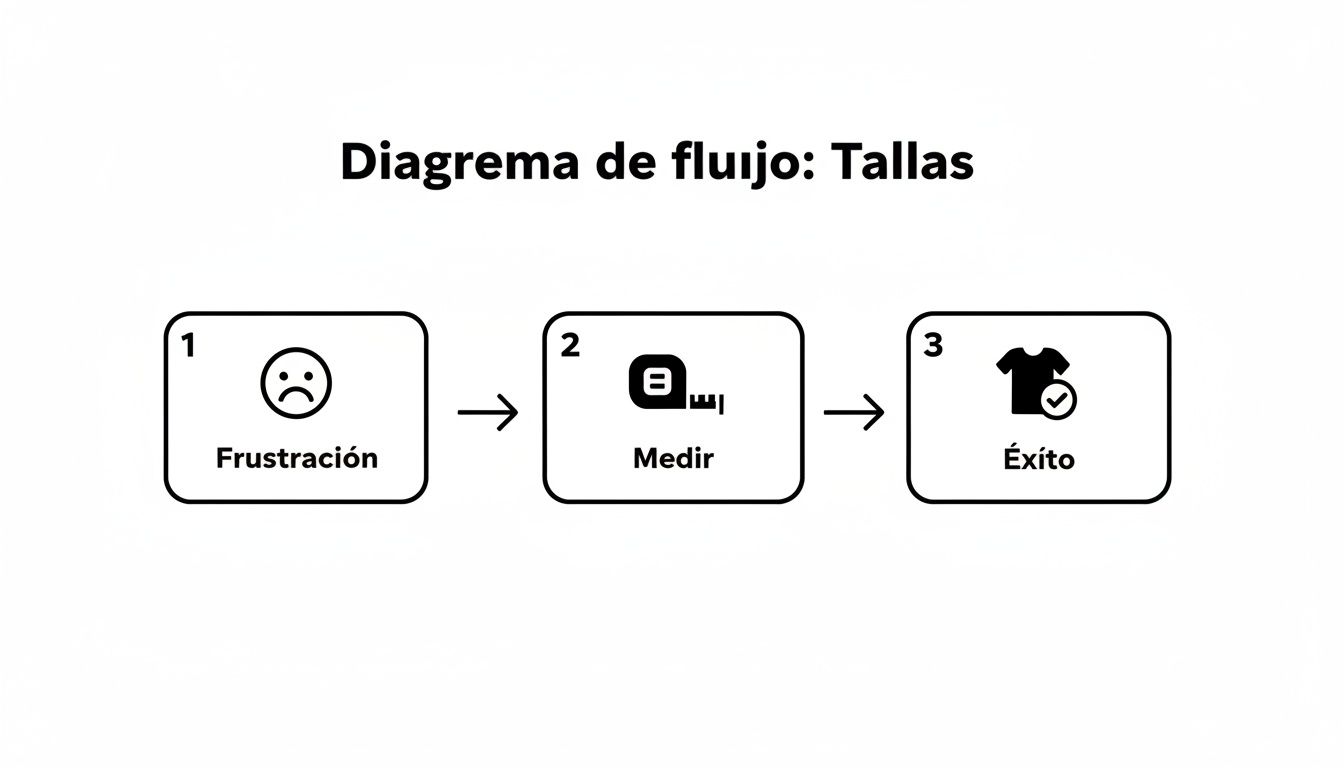
As you can see, measuring is the bridge that takes you from doubt to the perfect purchase. It completely transforms the online shopping experience.
Do you have a t-shirt at home that fits you like a glove? Great! That’s your golden standard. Instead of measuring your body, measure that garment.
The most reliable method for shopping online is to replicate a fit that you already know and love. Measure your favorite t-shirt flat and use those centimeters as your personal shopping guide. It’s a super simple trick that eliminates almost all room for error.
Lay the t-shirt on a flat surface, like a table or bed, and smooth it out well so there are no wrinkles. Then, take these two measurements:
With this data in hand, you’re more than ready to interpret the size charts from any store. This approach gives you complete control, especially if you’re thinking about more specific options like the ones explained in this ultimate guide to personalized t-shirts.
Okay, you’ve already got your measurements written down and the tape measure in hand. The moment of truth has arrived: facing the store’s size chart. That table, which sometimes seems written in another language, is actually your best ally if you know how to read it. Forget the panic, it’s easier than it seems.
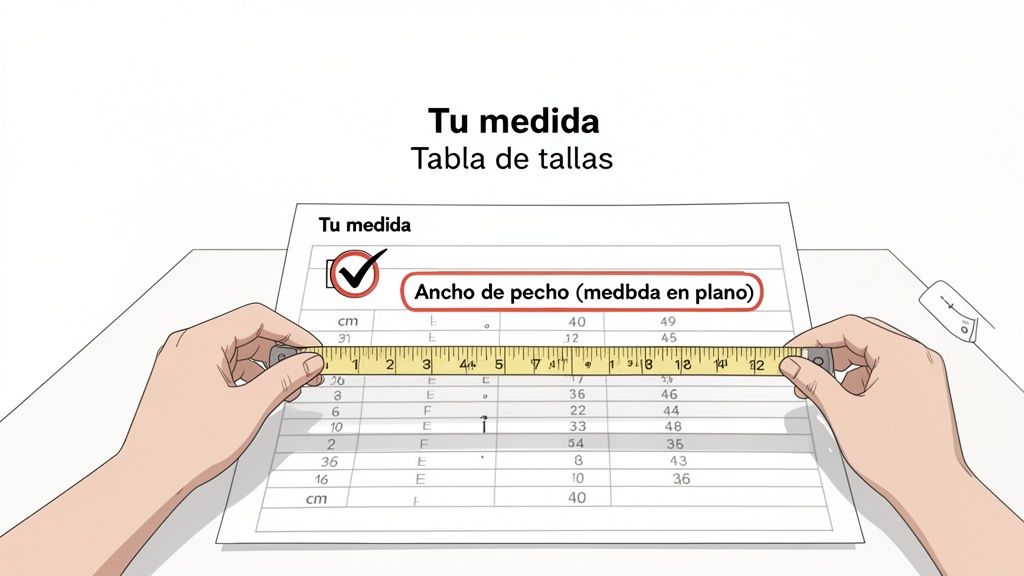
The first trick is to ignore the letters (S, M, L) for a moment and focus only on the centimeters. Take your chest, length and shoulder measurements, and compare them directly with what the brand gives you. This is where all the previous work makes sense.
Not all charts are the same, and sometimes they use concepts that can confuse you. It’s essential that you understand what each thing means so you don’t get a surprise when you open the package.
The big problem is that there is no law that standardizes sizing. This gets even more complicated when buying Batman or Deadpool t-shirts, where each manufacturer follows its own rules. The history of sizing in Spain has changed a lot since the 70s, but the lack of current regulations allows a size M from one store to have nothing to do with another’s. If you’re interested in the topic, in this CEAC analysis they explain it very well.
To give you a clearer idea, a well-made size chart usually looks like this:
Here you have a practical example of how a store (like ours, Geek T-Shirt Store) would present its sizes. Notice how the “Chest Width” is approximately half the recommended circumference.
| Size | Chest Width (cm) | T-Shirt Length (cm) | Recommended for (chest circumference in cm) |
|---|---|---|---|
| S | 48 | 69 | 90-96 |
| M | 52 | 72 | 97-104 |
| L | 56 | 74 | 105-112 |
| XL | 60 | 76 | 113-120 |
As you can see, if your chest measures 102 cm in circumference, size M would be yours.
It’s the most common dilemma in the world: your chest fits an M, but by height, the length of an L would be better for you. What do you do? The answer depends completely on how you like to wear your clothes.
If you’re torn between two sizes, the golden rule is to think about the fit you’re looking for. If you like a more fitted look (what they call ‘slim fit’), go for the smaller size. If you prefer to go more comfortably or the t-shirt is 100% cotton (which can always shrink a little), the larger size is your safest bet.
Remember that size charts are a guide, not an exact science. Use your measurements as a starting point and your own style as the deciding factor. With this approach, you’ll feel confident knowing exactly what you’re putting in the cart and you’ll forget about the uncertainty forever.
The geek universe has no borders, and that’s great. It means that the perfect t-shirt from your favorite anime could come from a store in the United States, United Kingdom, or anywhere on the planet. Shopping outside of Spain opens up a world of possibilities for you, but it also brings with it a small challenge: understanding sizing systems. Don’t worry, the conversion is much simpler than it seems.

Let’s get to the point: a European “M” size is not the same as an American “M”. As a general rule, US (US) sizes are larger and looser than their European (EU) counterparts. This happens because the cutting patterns and body measurements used as a reference in each market are different.
So you don’t get confused with weird calculations, here are some reference tables that will serve as a starting point for you. Of course, remember that they are a general guide. The size chart from the brand you’re going to buy from is always the one that matters.
Conversion table for men (or unisex fit)
| Spain Size (EU) | USA Size (US) | United Kingdom Size (UK) |
|---|---|---|
| S | S | 36/38 |
| M | M | 38/40 |
| L | L | 40/42 |
| XL | XL | 42/44 |
| XXL | XXL | 44/46 |
As you can see, in male sizing by letters, things are pretty straightforward between EU and US. On the other hand, in UK they often use numbers that refer to chest circumference in inches.
Conversion table for women
Here things change a bit more. The number system is completely different, so pay attention.
| Spain Size (EU) | US Size (US) | UK Size (UK) |
|---|---|---|
| 36 | 4 | 8 |
| 38 | 6 | 10 |
| 40 | 8 | 12 |
| 42 | 10 | 14 |
| 44 | 12 | 16 |
A practical tip that saves purchases: if a US brand doesn’t offer a detailed sizing chart, a good rule of thumb is to order one size smaller than what you wear in Europe. For example, if you normally wear an L, an American M will probably fit you perfectly.
The real trick to getting international shopping right isn’t just converting numbers, but understanding a bit of the “philosophy” behind how each country sizes clothing. The American market, for example, traditionally prefers more relaxed and comfortable cuts, which translates into wider clothing.
That’s why, even if the conversion gives you a size, it’s a great idea to read the product descriptions. Look for these key words that will give you the definitive clue:
In the end, the best tool for shopping online is still the one you already have: your own measurements in centimeters. Centimeters are a universal language that will let you shop with confidence in any store in the world. That way you make sure that every geek t-shirt you add to your collection fits you, simply, perfectly.
Having your measurements is the most important step, but don’t stop there. To master the art of sizing charts, there are two factors that can change everything completely: the cut of the garment and the material it’s made from. Trust me, ignoring them is a super common mistake that can ruin a purchase, even if the centimeters seemed correct.
Not all t-shirts are designed to fit the same way. A slim fit cut, for example, is meant to hug the body. If you value comfort and movement, it’s often a good idea to choose a size larger than what your measurements call for. On the other hand, an oversize cut gives you much more room, since its design is intentionally loose.
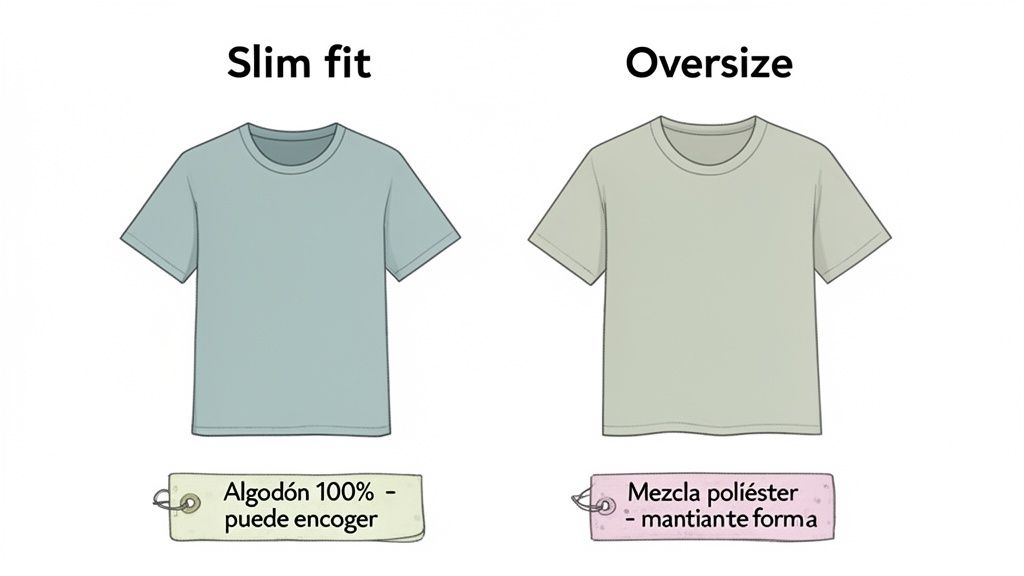
The material of the t-shirt is just as crucial as the cut. Fabrics not only feel different, but they behave very differently with use and washing. This directly affects how the garment will fit you in the long term.
My personal advice: for a 100% cotton t-shirt that you want to last, like that Demon Slayer t-shirt you love, I always consider the possibility that it will shrink 3-5%. If the size chart leaves me right at the limit between two sizes, I go up a size to be safe.
In the world of fashion e-commerce, where it’s estimated that up to 77% of shoppers fear not getting the right size online, understanding these details is key. For us, comic and video game fans, a guide that takes fabric into account can save us a lot of headaches. In the end, it’s estimated that men buy an average of five t-shirts a year, and ensuring the fit is perfect is vital for us to return to that store. If you want to know more, ecool.es has an interesting article about trends in men’s t-shirts and their online purchase.
We’ve reached the end of the guide, but it’s normal that you still have some questions on your mind. It happens to all of us. Learning to interpret a size chart is like anything else, you get better with practice. That’s why we’ve put together here the most common questions to give you clear and direct answers.
Think of this section as your personal cheat sheet for future purchases.
This is, without a doubt, the million-dollar question. You measure yourself, compare and boom!, you’re right between an M and an L. The final decision depends entirely on your style and how you like to wear your clothes.
Here’s a golden rule that never fails:
The key is being honest with yourself. Do you like tight clothes or more loose-fitting ones? There’s no right answer, only what makes you feel comfortable.
It’s not really recommended, to be honest. The cutting patterns are different for a very clear reason. Unisex or men’s t-shirts are more straight, while women’s fit t-shirts are designed more fitted at the waist and with more space in the chest and hip area.
If you’re a woman and you love a unisex cut t-shirt, the best thing is to guide yourself by the chest circumference measurement in the size chart. That said, you have to accept that the overall fit will be looser and straighter, it won’t adapt the same way to your body’s curves.
A reliable size chart is, above all, specific. Be wary of ones that only give you a letter (S, M, L) and nothing else. A good chart should always include concrete measurements in centimeters or inches.
Pay attention to these details to know if it’s trustworthy:
Absolutely! In fact, it’s one of the most effective tricks for getting the right size when buying online. Using a t-shirt you already know fits you perfectly as a reference eliminates almost all margin for error.
It’s very easy: lay your favorite t-shirt flat on a table, smooth it well so there are no wrinkles, and measure the width from armpit to armpit. Then, measure the length from the highest point of the shoulder to the hem. Compare those numbers with the size chart from the store. This method is incredibly accurate because you’re copying a fit you already know and love.
We hope this guide has given you all the tools to never get a size wrong again. Now, with complete confidence, we invite you to explore the incredible catalog of Tienda Camisetas Frikis, where every design is waiting to find its perfect fit with you. Discover your next favorite t-shirt here!
Hundreds of original designs waiting for you in the store.
Join the club and we’ll email your welcome coupon right away. Original anime, gaming and comic designs.