Sin categoría9 min read
What does the maneki neko mean and why does it raise a paw
By
Published on 17 de Aug 2026
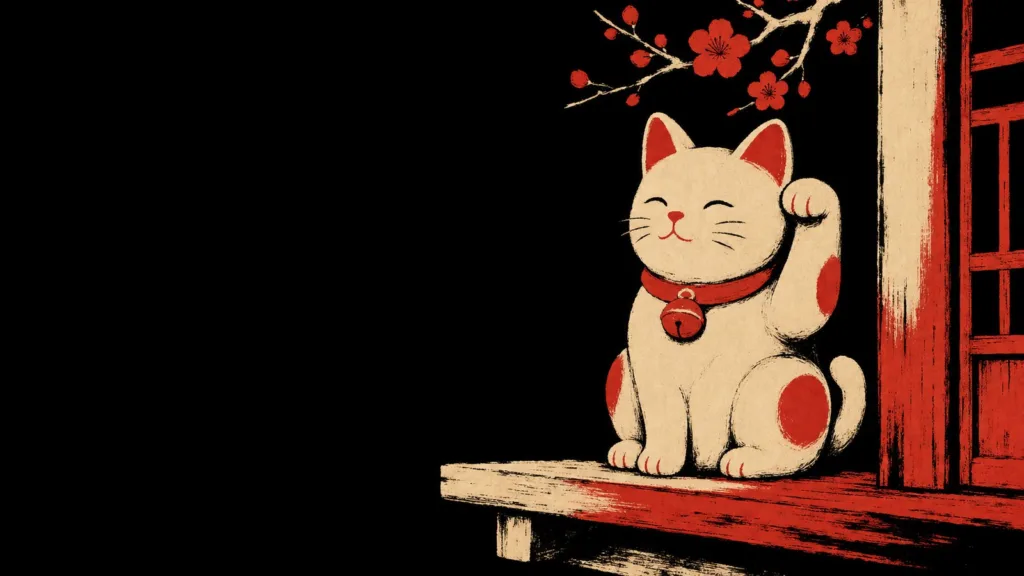
A ceramic cat with one paw raised watches over the entrance of thousands of Japanese shops, from a neighborhood hardware store to a noodle stall. The figure doesn’t wave goodbye: it calls. Its name is maneki-neko, which translates as “cat that invites,” and almost no one outside of Japan knows how to read its details. What maneki neko means depends on three very specific things: which paw it raises, what color it’s painted, and what it carries in the other paw. Change just one of those three elements and the cat’s message changes entirely. This text explains the real amulet, with its documented origin, and ends with a detail that anyone fond of board games or role-playing games will recognize right away.
The maneki-neko’s gesture copies a very specific Japanese movement: palm facing down, with fingers curving toward the body. In the West that same sign is read as a goodbye; in Japan it means “come here.” That’s why the cat doesn’t wave goodbye to anyone from the window display, but instead invites them to enter. The raised paw works like a silent beacon: the higher the sculptor raises it, the farther away the call is supposed to reach.
Almost all models share a sitting posture, with the tail curled up and a bell around the neck. That bell comes from the collars that merchants used to put on shop cats, to know where they were among the merchandise. Over time, the ornament became purely decorative. Today it marks the tradition without fulfilling any practical function.
Behind the figure lies a very simple commercial logic. A business needs customers and needs money at the same time, and the maneki-neko separates both desires into two distinct gestures. No one asks for both things with a single arm: each paw does its job. That division explains why the same cat appears in such different versions depending on the display window where it’s placed.
The right paw raised calls in money. A business looking for income, savings, or investment almost always places this version near the cash register. The left one, on the other hand, calls to people: new customers, visitors, company. A restaurant that lives by word of mouth prefers this variant by the door, where anyone passing by on the street sees it first.
There is a third, less common option: the cat with both paws raised at the same time. This figure asks for general protection for the home or business, without specializing in money or company. Some souvenir shops sell it as the most complete version, although traditional Japanese commerce still prefers the single gesture of just one paw.
It seems to me that this very precise specialization is the most interesting thing about the symbol. A small object, made of cheap ceramic in many cases, condenses two distinct economic desires in a single hand gesture. No text, no instructions: just look at which paw is in the air to know what the shop owner is asking for.
The Gotokuji temple, in the Setagaya district of Tokyo, preserves the version with the right paw raised as the most common among its thousands of votive figures. Visitors leave ceramic kittens as offerings of thanks when their wishes are granted, and the courtyard is covered with entire rows of these white figures.
White was the original color and remains the most widespread. It represents general luck, without nuances or specialties. Very close is the tricolor, with black and orange spots on a white background, the combination that in Japanese is called mike and is considered the most fortunate of all, especially for those who travel or open a new business.
Black wards off the evil eye and negative energies. Many Japanese families place it near their front door for protection, not as a commercial appeal. Gold points directly to wealth, so it appears mainly in stores and offices. Red is associated with health and is usually given to someone recovering from an illness. Pink speaks of love, and green, in its more modern version, promises success in studies.
That range of colors did not come out of an ancient manual written all at once. It expanded over decades as manufacturers discovered that a new color sold well for a specific occasion. Only white and tricolor appear already in the oldest figures that survive; the rest came later, driven by the gift market.
Paying attention to the color rather than the paw gives a quick clue about what type of establishment is ahead. A stationery store with a green cat on the counter probably also sells study materials. A clinic with a red one at the entrance reinforces its health message without needing any sign.
Two legends dispute the origin of the maneki-neko, and neither can be fully confirmed. The most cited one occurs at the Gotokuji temple during the Edo period. A feudal lord named Ii Naotaka (1590 and 1659 are his birth and death years) took shelter under a tree near the temple during a storm. A female cat belonging to the monk who lived there seemed to call him by waving her paw from the doorway. Naotaka came over to look at her and, just then, lightning struck the tree under which he had been sheltering seconds before. Grateful to be alive, he became a benefactor of the temple and financed its reconstruction.
The second legend comes from the Imado neighborhood in Asakusa. A poor elderly woman could not feed her cat and had to let it go. That same night, the animal appeared to her in a dream and told her that if she molded figures in its shape, it would bring her fortune. The woman took heed, made ceramic cats with the local Imado-yaki technique and sold them near an Asakusa shrine. The figures sold out immediately and the elderly woman escaped poverty.
The oldest documented record that survives is an engraving by Utagawa Hiroshige from 1852, which shows a street stall selling clay cats in Tokyo. From that date on, the figure steadily gained popularity for the rest of the century, until it became a common object in stores and homes. The design with the golden coin on the paw, so recognizable today, did not arrive until 1950, when workshops began to replace the bell with a koban, the ancient oval Japanese coin, engraved with enormous figures of imaginary fortune.
Anyone who plays board games or role-playing games will recognize the cat’s gesture as soon as they think about it for two seconds. A small figure that does nothing on its own, placed in just the right spot, whose only function is to add an invisible point of luck to what you’re already doing. It doesn’t heal, doesn’t attack, doesn’t move pieces. It only pushes the odds a little in your favor, just like any gaming table charm that someone keeps next to the dice just in case.
That reading doesn’t betray the original symbol: it continues it. The maneki-neko was born precisely for that, to slip into a corner of the shop and work silently while the owner takes care of what’s important. A player who rubs the figure before a decisive roll is doing, without knowing it, the same thing a shopkeeper in Tokyo did more than a century ago: asking the cat for an extra push, with no guarantees, just in case it works.
The visual repertoire of Japanese art is full of similar winks, symbols that started with a very specific ritual meaning and today coexist with geek culture without losing their origin. The same happens with the messenger foxes of Shintoism, another animal figure that reads as both protective and mischievous. And it happens with the gateways that mark the passage from the everyday to the sacred, like the torii that frames the entrance to a shrine: both symbols share that idea of a boundary you cross so that something changes.
The maneki-neko is a very specific Japanese symbol, with a posture, gesture and colors that have been coded for generations. A generic lucky cat can have any shape. The Japanese figure, on the other hand, is always recognized by the raised paw with the palm facing the body, the bell around the neck and the tail coiled under the sitting body.
It does matter, although there’s no amulet police watching over it either. The right paw is associated with money and is good to have near a cash register or work desk. The left one calls for visitors and works better near a door or entrance. Choosing one or the other depends on which wish you want to put first.
The Gotokuji temple in Tokyo is the most associated with its origin thanks to the legend of the feudal lord and the lightning. But it’s not the only one: the Imado neighborhood in Asakusa defends a different story and also claims the credit. Neither of the two legends has definitive proof, so they coexist as parallel versions of the same origin.
Hundreds of original designs waiting for you in the store.
Join the club and we’ll email your welcome coupon right away. Original anime, gaming and comic designs.