Sin categoría9 min read
What does the koi fish mean and the legend of how it became a dragon
By
Published on 16 de Aug 2026
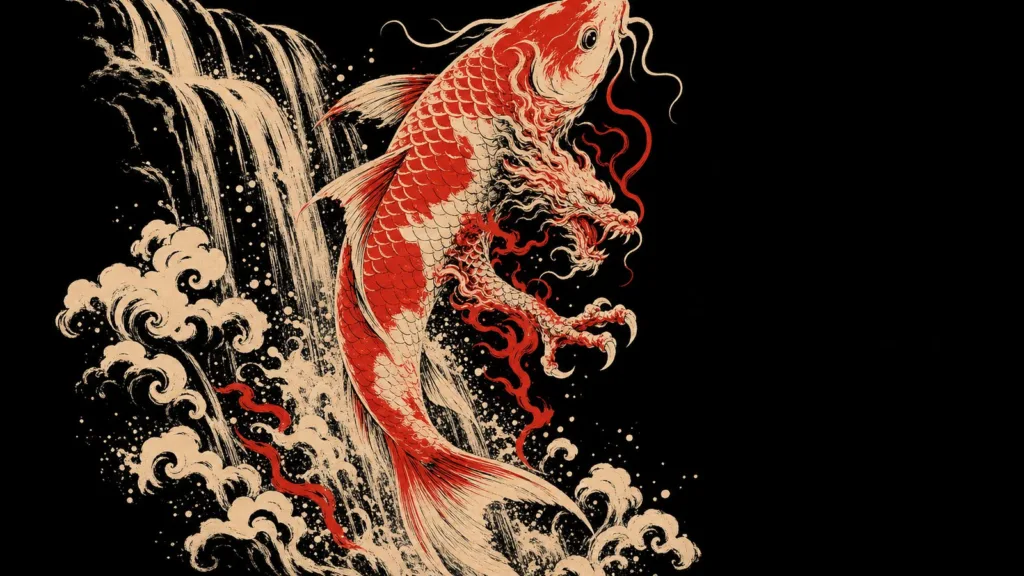
The koi carp swims against the current of mountain rivers, jumps short waterfalls and withstands winter cold without stopping moving. That stubbornness, so simple to observe in a pond, explains why generations of Japanese artists painted it on folding screens, engravings and cloth banners. Behind the colored fish there is a myth much older than Japan: that of a carp that climbs an impossible waterfall and transforms into a dragon. And behind that myth there is a question that still brings people here: what does the koi carp mean, beyond being beautiful in the water.
This article tells the complete legend, explains the meaning of the colors of Japanese varieties and ends with a modern reading that will sound familiar to more than one: leveling up by trying again.
Koi is simply the Japanese word for carp. The colored fish that we all imagine is actually called nishikigoi, “brocade carp”, an ornamental variety bred from the common carp that farmers had in rice paddies as a source of protein. That ordinary carp has nothing exotic about it. Its colored version does, and that’s where the difference between a farm fish and a symbol begins.
That symbol is based on three ideas that are repeated throughout Japanese koi iconography: the strength to swim against the current, the patience to endure in cold or murky waters without dying, and the determination to keep trying something even though the first dozen attempts go wrong. It’s no coincidence that it appears in tattoos representing overcoming a difficult stage, nor that it decorates temple ponds where calm is sought. That fish has been carrying that symbolic weight for centuries without needing a single written word on top of it.
That origin of the color varieties has a fairly concrete story and less mythical than it seems.
The breeding of ornamental carp was born in the mountain villages of Niigata Prefecture, in the Chūetsu region, during the Edo period. The farmers in that area spent long winters with their carp confined in ponds covered with snow, and some were born with red or white spots due to spontaneous mutation. Instead of discarding them, they began to select and cross them on purpose. That’s where what is known today as nishikigoi was born, with more than 200 years of selective breeding behind it.
Niigata remains the reference home of exhibition koi, and the oldest varieties (the white and red kohaku, then the sanke and showa) came out of that same handful of towns. Anyone who wants to delve deeper into how Japanese art turned a pond fish into a decorative motif has, within Japanese art, an entire tradition of engravings and paintings built around this same image.
The result of two centuries of selection is reflected in the price that the best specimens fetch today: a single prize-winning carp was once sold for 203 million yen at an auction in Japan. That fact has nothing to do with the cultural meaning of the fish, but it does demonstrate how far the prestige it carries goes.
The story does not originate in Japan, but in ancient China, and later arrives in Japan under the name tōryūmon. The legend tells that in the upper course of the Yellow River there was an extremely high waterfall called the Dragon Gate, so violent that almost no creature managed to overcome it. Each spring thousands of carp swam up the river from the sea, swimming against increasingly strong currents, until they reached the foot of that waterfall.
There most would give up. Some returned downstream, others stayed circling in the same eddies. Only one carp, the tale says, insisted year after year without letting itself be defeated by the force of the water, until one day it managed to jump the entire waterfall in a single leap. In that instant the gods rewarded it by transforming it into a dragon: amid thunder and lightning, the carp changed its skin, claws grew, and it disappeared flying toward the sky.
That reading of the legend changed depending on the place and the century, but the core remained intact. In imperial China it was used as a metaphor for passing the civil exams that opened the door to public office: “jumping the Dragon Gate” meant rising in status through effort, not birth. In Japan, the same story became a symbol of perseverance in the face of any obstacle, the same way a torii marks the passage from an ordinary space to a sacred one. If you’re interested in that idea of doors and thresholds in Japanese symbolism, the article about the Japanese torii goes deeper into another gate charged with the same kind of meaning.
What stands out most about the legend, and here I allow myself an opinion, is that it does not reward the strongest fish or the largest. It rewards the one that tries again after failing in front of the same waterfall for years. That is the part that survives best the passage of time.
Each variety of nishikigoi has its own color pattern, and Japanese breeders have spent decades polishing names and classifications for each combination. The three most revered varieties are known as the “gosanke,” the big trio of show koi.
Kohaku is white with red patches, with no other color in between. It is the oldest variety and the one usually considered the starting point of modern koi; it represents purity and a type of clean success, without frills. Sanke adds to the white and red some small, well-distributed black patches, and is read as a symbol of balance between strength and delicacy. Showa inverts the base: the body is black and upon it appear red and white patches, a reading that is associated with overcoming a difficult period, as if the dark color represents the adversity the fish carries and manages to wear with pride.
Outside of the gosanke there are other varieties with their own meaning. Golden or silver in a single metallic tone, the ogon is related to prosperity. With a bluish back and reddish belly, the asagi refers to the sky and water at the same time. Red, in general, is associated with courage and love; black, with overcoming adversity; white, with purity of intentions. No color is “the good one”: the combination counts as much as each tone separately, just as in Japanese folklore the fox kitsune changes nature depending on the number of tails attributed to it.
On May 5th, Japan celebrates Kodomo no Hi, Children’s Day, and on that day thousands of homes hang koinobori: fabric sleeves shaped like carp that wave in the wind as if swimming through the air. That tradition comes from the flags that samurai families placed to announce the birth of a male son; over time, the common people adopted the custom and replaced the family crest with the figure of the carp, precisely because of its reputation for swimming against the current without giving up. Each color plays its role: the black one usually represents the father, the red one the mother, and the others each son of the family.
This is where the legend of the Dragon Gate stops sounding like an old tale and starts sounding like something else. Removing gods, thunder and golden scales, the story describes something quite recognizable: an attempt that fails, is repeated, fails again and one day, without much changing on the outside, it succeeds. Anyone who has insisted on learning a language, getting a degree late or starting a small business recognizes the pattern. No coincidence turns the carp into a dragon on the first jump. It returns to the waterfall over and over again, after the two hundredth jump, and that’s why it transforms.
That reading connects naturally with the language that video games and learning apps use today: level up, unlock the next phase, improve the stat by repeating the same test a thousand times. The image of the carp that goes up the current until it transforms works as a metaphor for leveling up centuries before the word “level” existed in that sense. The myth changes setting, but the underlying mechanic (try, fail, try again, improve a little each time) is exactly the same.
It depends on the direction it’s swimming. A koi carp swimming upward in the design is usually read as determination and active struggle against adversity; one swimming downward is interpreted as the person having already overcome that stage and living in calm after having achieved it.
Because of the Chinese legend of the Dragon Gate, later adopted in Japan as tōryūmon: a carp that manages to climb a mythical waterfall in the upper course of a river transforms into a dragon as a reward for its persistence. That story became a metaphor for progressing through effort and not by chance.
No. The general meaning (strength, patience, overcoming) is maintained in all of them, but each color pattern adds a different nuance: the kohaku speaks of purity, the sanke of balance, the showa of overcoming adversity, and the ogon of prosperity, among other varieties recognized by Japanese breeders.
Hundreds of original designs waiting for you in the store.
Join the club and we’ll email your welcome coupon right away. Original anime, gaming and comic designs.