Gaming27 min read
How to play League of Legends: Beginner’s Guide
By
Published on 16 de Jun 2026
Getting into League of Legends for the first time may seem crazy, but it’s actually easier than you think. The key is not trying to learn everything at once. Focus on three things: download the game, understand what the keys (Q, W, E, R) do and choose a champion recommended for beginners. From there, each match is a new lesson that will make you better.
Welcome to the Summoner’s Rift! If right now you feel bombarded by an absurd amount of information about LoL, don’t worry, it’s normal. This guide is designed just for that: to take you from confusion to action and give you the right and necessary tools so you can play your first match without having a heart attack.

The first step has no mystery. All you have to do is go to the official League of Legends website and download the Riot Games client. The installer guides you step by step, so it’s straightforward.
When it’s done, it will ask you to create a Riot account. This account is your master key to LoL and the rest of their games. Think carefully about your summoner name, because it will be your identity in the game and how others will know you.
When you open the client for the first time, you’ll see a bunch of menus and options. Don’t stress. At first, you only need to control three things:
Really, forget about everything else. Your only mission now is to know where the “Play” button is and how to pick your character.
“The learning curve in LoL is steep, but each concept you master, no matter how small, becomes a tangible advantage. Focus first on moving and using abilities; the rest will come with practice”.
Okay, you’re inside the Rift. Your screen is now full of information, and knowing how to read it is the difference between winning and losing.
Moving around the map is simple: right-click on the ground and your character will head there. To attack an enemy, right-click on them. Easy, right?
The magic starts with abilities, which are activated with the Q, W, E and R keys. Most of them will require you to aim with the mouse and then left-click to cast them. Spend your first games practicing this: move constantly and cast abilities. It’s a key mechanic that will give you a brutal advantage.
And if you want to take your passion for the game beyond the screen, you can always grab a few League of Legends t-shirts to feel like a true player even when you’re not in the Rift.
League of Legends is not a game for lone wolves. It’s a five-versus-five battlefield, where coordination is everything. Each player takes on a role, a position with unique responsibilities that are key to victory. Understanding what each one does is the first step to playing effectively.
Think of it like a football team. You can’t have five forwards; you need defenders, people in midfield and a goalkeeper to cover everything. In LoL it’s exactly the same. Success depends on everyone fulfilling their function and playing for the team. Let’s break down the five roles so you can see which one fits best with your style.
The top lane, or Top Lane, is a long line that’s quite isolated from the rest of the map. It’s the terrain of the toughest champions, the so-called tanks or fighters, tough beasts capable of taking a lot of punishment and surviving on their own.
As a top laner, your world is reduced to a constant duel against your direct rival. Your goal is to master the art of farming minions while looking for opportunities to get an advantage that allows you to pressure their turret. Since you’re far from the main action, being self-sufficient is fundamental. Don’t expect babysitting at the start.
The role of the Jungler is completely different, because it doesn’t have a fixed lane. Your domain is the jungle, that space between lanes where you defeat monsters to get gold and experience. Your impact on the game is brutal, since you’re in charge of creating opportunities all across the map.
A good jungler keeps one eye glued to the minimap constantly. Is the enemy mid laner playing too far forward and fed? Well, that’s the perfect moment for an ambush (gank). Your decisions are critical: you have to know when to farm for yourself, when to help a teammate in trouble, and when to secure key objectives like dragons.
If you like strategy and enjoy feeling like you influence the entire game, the jungle is your place. To master this position, you can draw inspiration from iconic champions like the blind monk Lee Sin, a character that perfectly embodies the potential of a good jungler.
The central lane, or Mid Lane, is the shortest line and, for that very reason, one of the most explosive. This is where mages with tremendous ranged damage or assassins capable of erasing a target from the map in the blink of an eye usually shine.
Being right in the center, the mid laner has direct access to any part of the map. This gives them enormous responsibility: not only do they have to win their lane, but they must be ready to rotate and help the jungler or the side lanes. A mid laner who gets ahead can swing the entire game for their team.
Your true impact as a mid laner is not measured only by how you destroy your direct rival, but by your ability to move that advantage across the map. A timely rotation can mean a free dragon or a double kill in the bottom lane that puts your team ahead.
The ADC (Attack Damage Carry), or Marksman, is the team’s piece in charge of dealing physical damage non-stop, especially as the game progresses. They play in the bottom lane, always accompanied by their Support.
Champions of this role tend to be paper, very fragile, but with ranged damage potential that’s scary. Your main job is to survive and farm every last minion to buy expensive items that boost your attacks. In fights, your positioning is everything: you have to stay behind your tanks while annihilating enemies from a safe distance.
The Support, or Support, is the guardian angel of the ADC in the bottom lane. Your mission is to protect your marksman, fill the map with vision wards, and set up plays so your team can shine.
Not all supports are the same, there are several types:
Although they don’t get the spotlight or the kill statistics, a good support is the pillar upon which victory is built. Their map control and ability to save a teammate in the last second is something that, simply put, wins matches.
In League of Legends, it’s very easy to get carried away by the adrenaline of combat and think that the only thing that matters is getting kills. But if you want to truly learn how to play League of Legends, you have to get something into your head: eliminations are just a tool, not the final objective. Victory comes when you destroy the enemy Nexus, and to make your way to it, you need to control the map objectives.
These objectives are key structures and neutral monsters that give strategic advantages to your entire team. We’re talking about gold, experience and permanent upgrades that can turn around a losing match. Ignoring them is, without a doubt, one of the biggest mistakes that beginners make and the reason why many teams lose even when they’re ahead on the elimination scoreboard.
Towers are your first major obstacle in each lane. They not only defend the lane, but also create a safe zone for the team that controls them. Destroying an enemy tower is not just getting a good sum of gold that’s shared among everyone, it’s much more than that: it’s “opening the map”.
This concept is fundamental. When you eliminate a tower, you take vision away from the rival team and gain control over that part of their jungle. This makes ambushes much easier and makes it risky for them to move through their own territory. In fact, the first tower that falls in the match grants a bonus gold reward, making it an absolute priority.
A good tip for beginners is this: if you kill your lane opponent or force them to return to base, don’t just stand still. Take advantage of that time to let your minions start hitting their tower. Every little hit counts and brings you one step closer to knocking it down.
In the lower part of the river you’ll find the Elemental Dragons. There are four types (Infernal, Mountain, Ocean and Cloud), and each one gives your team a permanent upgrade that accumulates each time you defeat one. For example, the Infernal Dragon gives you more damage, while the Mountain Dragon increases your armor and magic resistance.
But the true power of dragons is unleashed when a team manages to kill four. By doing so, they obtain the Dragon Soul, a powerful upgrade for the entire match that, very often, is enough to seal the result. That’s why, from the middle of the game on, dragons become a constant point of conflict.
Meanwhile, in the upper pit, before the clock hits the 20-minute mark, the Herald of the Rift appears. This monster is your best friend for taking down structures. When you defeat it, you can summon it to charge at full speed against enemy towers. Its headbutt deals a brutal amount of damage, making it the perfect tool for opening lanes and accelerating the game.
The Herald is key in the early and mid game for breaking defenses and securing that invaluable first tower.
The following infographic helps you visualize how these objectives fit into the progression of a normal game.
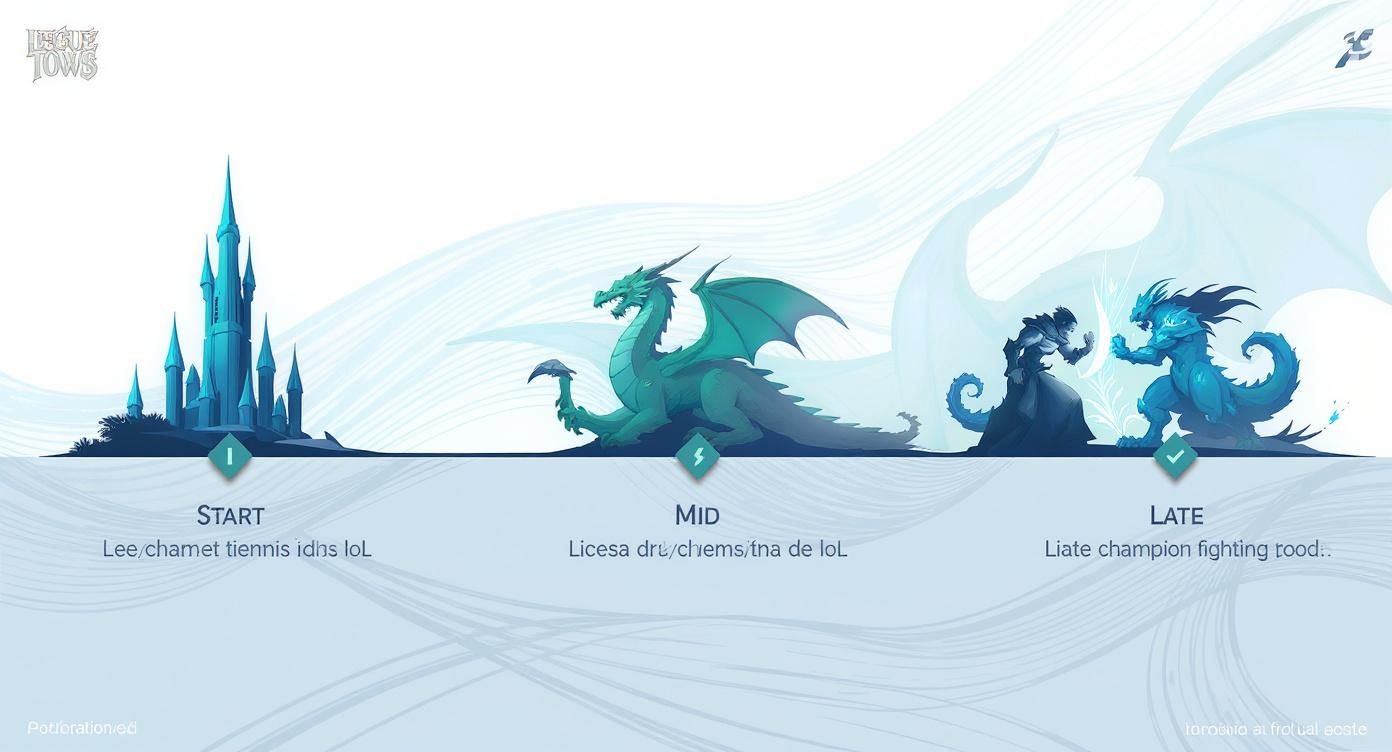
As you can see, the focus changes. At first you focus on towers, then attention shifts to objectives like dragons, and finally everything culminates in decisive team fights that determine the winner.
From the 20-minute mark onwards, the Herald disappears and in its place emerges the most powerful monster in the game: Baron Nashor. Killing it gives your entire team the “Hand of Baron” buff, which massively strengthens your nearby minions and lets you return to base much faster.
This buff is basically a siege mode. With it, your waves of minions become almost unstoppable, allowing you to pressure all lanes at once and tear down enemy defenses like they’re made of paper. Securing Baron is usually the final push needed to close out a tight game or turn around one you thought you had almost lost.
That said, be careful. Trying to kill Baron is a high-risk play. It leaves you very vulnerable to a counterattack from the enemy team that, if it goes wrong, can cost you the entire game.

Once you set foot in your lane, the game becomes a delicate dance of strategy and skill. Your immediate success won’t depend on spectacular plays across the map, but on two fundamental tasks: earning more gold than your direct rival and coming out ahead in small skirmishes.
Gold is the engine that drives your champion. It’s what allows you to buy items to be stronger, more resistant, or to make your spells hit harder. And the most consistent and reliable source of income you’ll have are minions, those small creatures that advance relentlessly down each lane.
Every time an enemy minion dies near you, you gain experience. Easy. But to take the gold it drops, it’s not enough to be nearby: you have to be the one who deals the killing blow. This technique is known as ‘last hit’ or ‘farming’, and it’s, without a doubt, the most important skill you need to learn at the beginning.
A player who gets 80 minions in 10 minutes will have a brutal economic advantage over someone who has only killed 40, even if both are tied in eliminations. This difference in gold translates directly into more powerful items and, therefore, into winning fights more easily.
"At the beginning, forget about constantly harassing your rival. Your number one priority is not to miss a single last hit. Every minion that gets away from you is gold you’re giving to your opponent".
A good trick to improve is to get into the game’s practice tool and spend 10 minutes just trying to deal the final blow to all minions. No rivals, no pressure. You’ll see how your income in real matches skyrockets.
When you feel more comfortable farming, the next step is to start interacting with your opponent. A ‘trade’ or damage exchange is, basically, a short fight where you both throw some abilities and attacks at each other. The objective is simple: deal more damage to the other person than you lose.
The perfect moment to initiate a trade is right after your rival has used an important ability to kill a minion. At that instant, that ability is on cooldown and they won’t be able to use it against you. That’s your window of opportunity to attack.
For ranged champions, like ADCs (attack damage carries) or many mages, there’s a key mechanic called ‘kiting’. It consists of attacking and moving almost at the same time, taking advantage of the small gap between one basic attack and the next to change position.
Imagine a melee champion, like Garen, running straight at you. Instead of staying still shooting like a turret, you do this:
With this technique, you keep dealing damage to him while maintaining a safe distance, making it very difficult for him to reach you. Mastering kiting is what separates a good ADC from an exceptional one.
To wrap up, let’s talk about one of the pillars of the game that newbies ignore the most: vision. The map is covered by a “fog of war” that prevents you from seeing what isn’t near your allies or your structures. To clear it, you need to use vision wards (wards).
Placing wards in strategic points, like the river bushes or the entrances to your jungle, gives you vital information. It lets you see if the enemy jungler is approaching to ambush you, giving you plenty of time to retreat.
A well “warded” map is the best defense that exists. It’s a habit you should pick up from your first match; it will save your life countless times and is one of the clearest ways to show that you know how to play League of Legends intelligently.
Your champion doesn’t get stronger just by leveling up. The real power spike, what truly turns the tide of a match, comes from the items you buy and the runes you choose before you start. This entire system is known as a build.
At first, it might seem like a universe of infinite options, but don’t worry, it all follows pretty simple logic. Understanding it is what will allow you to adapt and always be a threat to the enemy team.
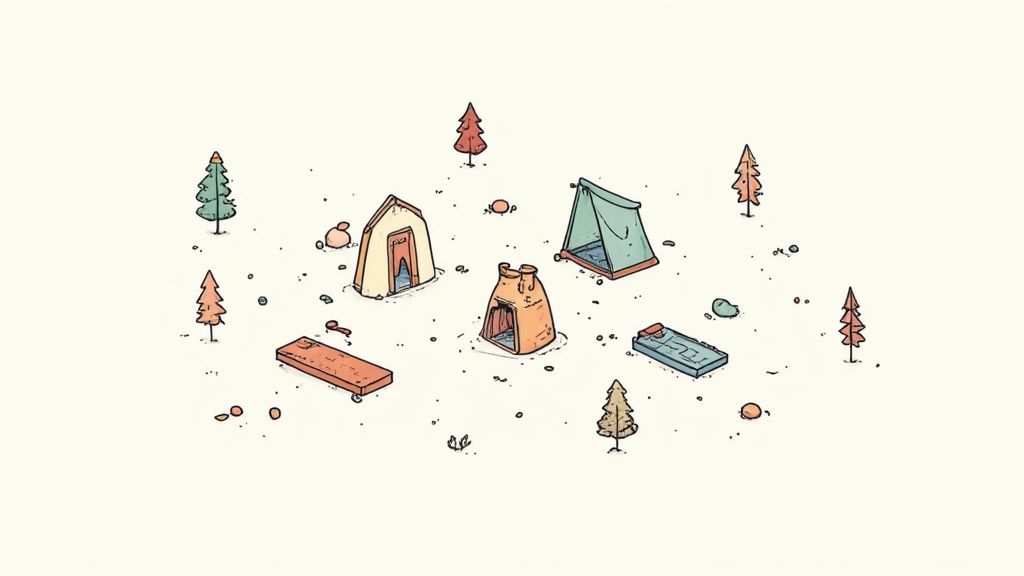
The goal of a good build isn’t to blindly follow a guide, but to make smart decisions on the fly. Learning to build your champion is, without a doubt, one of the most important skills to progress in this game.
Before the match starts, you have to choose a rune page. Imagine them as passive talents that define your playstyle from minute one. They give small bonuses that make big differences.
You don’t have to memorize the more than 60 runes that exist. At first, the best thing is to fully trust the default pages that the game offers you. They’re designed by experts and work wonderfully. Over time, you’ll start to understand what each one does and you’ll be able to customize them, but don’t stress about it now. The important thing is that you never enter a match without a rune page selected.
In-game, the gold you earn killing minions or eliminating enemies is spent in the shop. You can open it in your base by pressing the P key. Items are the main engine of your champion’s power, and they’re divided into two main damage categories:
Each champion scales better with one of these two statistics (and sometimes with both). The store will always recommend items that work well for your character, so at first you can trust its suggestions without fear. It works like this: you buy small components that you then combine to create much more powerful items.
The structure of a build tends to be quite similar in most matches. Generally, you’ll start by buying boots to move faster and, right after that, you’ll focus on your first major item: the Mythic item.
Mythics are core pieces that define how your champion works, as they grant unique and very powerful passive effects. You can only have one at a time, so choosing the right one is a crucial decision.
After the Mythic, you’ll continue with Legendary items. These are the other pieces that complete your build and specialize you in certain areas: dealing more damage, having more health, reducing cooldowns, etc. A complete build usually consists of boots, one Mythic item and four Legendary items.
Adaptation is the most important ability when buying items. If the enemy team has many mages that are wiping you off the map, it’s much smarter to buy a magic resistance item than to blindly follow a guide that recommends you buy more damage.
This is where novice players are separated from those who are starting to master the game. An item guide gives you a safe route, but every match is its own world. The key to success is adapting your item purchases to what’s happening in this match.
Put yourself in these situations:
Don’t be afraid to deviate from the recommended route if the match requires it. Analyzing the enemy composition and their items (by pressing tab) will give you all the information you need. For inspiration, you can take a look at character designs like Jinx, whose potential skyrockets with the right items.
Getting into the League of Legends universe is a brutal adventure, but it’s totally normal to feel lost at first. The game is huge and has a thousand details, so we’ve gathered the questions that are asked most often by newbies so that your entry into the Rift is as smooth as possible.
That’s the million-dollar question, and the honest answer is: it depends on you. Getting the basic controls down and understanding what the heck your champion does can take you a couple of matches. Now, mastering the game… that’s something that never ends. There’s always something new to polish.
Don’t stress about this. At the beginning, the goal isn’t to be a pro, but to have fun while you learn. Focus on improving one thing at a time, like last-hitting minions or learning where to place a vision ward. After about 20 or 30 games, you’ll feel much more comfortable with the basics.
Not at all. League of Legends is a true ‘free-to-play’ game, and one of the best ones out there. You can unlock every single champion and runes just by playing and earning the in-game currency, Blue Essence.
Real money (Riot Points or RP) is only for buying cosmetic stuff: skins for your champions, emotes, ward skins… These are extras that give you zero advantage in the game. Absolutely zero. So don’t feel pressured to open your wallet.
It’s going to happen. A lot. Even though the matchmaking system tries to keep games balanced, sometimes you’ll run into a rival who’ll leave you shivering under your tower. When that happens, take a deep breath and change your mindset.
Your goal is no longer to win the lane, but to lose it with as much dignity as possible. Switch to defensive mode, stay near your tower, and focus on grabbing minions you can get without risking your life. You can ask your jungler for help, of course, but don’t count on them being your savior. Just surviving and not giving your rival more gold is already a win.
Don’t forget: every game, especially the ones where you get stomped, is a lesson. Pay attention to what your opponent did well and think about what you could have done to keep them from getting such a big advantage.
When you reach level 30 and have at least 20 champions, you’ll unlock ranked matches. You’ll play 5 placement matches and the system will place you in an initial rank.
Ranks go from Iron (the lowest) to Challenger (the elite). The vast majority of players are in the middle ranks. For example, in the Spanish community, only 1.7% of players reach Platinum I, while 21% are in Gold and another 21% in Silver. This gives you an idea of how much of a constant challenge climbing is. If you’re curious, you can check out more about rank distribution in the LoL community.
Each win gives you League Points (LP) and each loss takes them away. When you reach 100 LP, you play a promotion to try to climb divisions.
Not all champions are for newcomers. Some have mechanics that can drive you crazy at first. To start off on the right foot, we recommend champions with simple abilities that get straight to the point:
League of Legends is competitive, and sometimes people get too intense. You’re going to run into toxic players, it’s inevitable. Your best weapon against them is the mute button.
If a teammate starts venting bile in chat, don’t engage with them. Press tab to open the scoreboard and click on the speech bubble icon that appears next to their name. Their chat will disappear and your game will improve instantly.
And remember that this is a game. If you notice you’re getting angry, stop and take a breather. Playing tilted (angry) will only make you commit more mistakes and have a worse time.
At Geek T-Shirt Shop we know that being a gamer is much more than a hobby. That’s why we have an incredible collection of designs inspired by your favorite champions and games. Check out our website and find the t-shirt that screams your passion for the Summoner’s Rift. Take a look at https://tiendacamisetasfrikis.com
Article created using Outrank
Hundreds of original designs waiting for you in the store.
Join the club and we’ll email your welcome coupon right away. Original anime, gaming and comic designs.