Movies & Series27 min read
The definitive guide to the history of the Marvel universe
By
Published on 15 de Jun 2026
The history of the Marvel universe is much more than a simple accumulation of comics since 1939. Imagine it as a gigantic narrative tapestry, a universe that spans from the origin of everything to nightmare futures, woven with thousands of stories. It is not a single narrative, but a vast and interconnected chronology that shapes heroes, villains and entire civilizations, almost always with the focus on our main reality: the famous Earth-616.
The Marvel universe is not just a collection of comics; it is a living cosmos, constantly changing, with its own rules, cosmic cataclysms and a timeline that, although sometimes tangled, follows an internal logic that captivates. Thinking about its history is not just remembering how Peter Parker got his powers or when the Avengers first came together. It is understanding the thread that binds it all together.
From the creation of the cosmos by beings of unimaginable power to the secret wars that turned reality upside down, each adventure, no matter how small it may seem, leaves its mark. All of this officially started in 1939 with Timely Comics, laying the foundation for what today is a worldwide phenomenon.
What makes this story great is its ability to reinvent itself. It is not a story set in stone, but one that breathes, grows and sometimes contradicts itself, reflecting the concerns of each generation. To not get lost in its more than 80 years of publications, you have to be clear about some key concepts:
Understanding the history of the Marvel universe is like learning the mythology of a modern civilization. Its gods are beings with cosmic powers, its heroes face very human dilemmas and its legends are written in panels that have inspired entire generations.
Throughout this guide, we are going to break down this universe step by step. We will start with its editorial origins, travel through the eras that shaped it and stop at the events that made its foundations tremble. Get ready for a journey from the Big Bang to the most current sagas to discover how the world’s most famous fictional universe was built.
To truly understand how the complex and vibrant Marvel universe we know today works, you have to take a trip back in time to its foundations. The history of Marvel didn’t appear out of nowhere; it was simmering on a low fire for decades, in different eras that functioned as the pillars of all its mythology. Each of these stages was a reflection of its time, introducing characters and ideas that would end up defining the future.
Imagine that these eras are like the layers of an ancient city. The deepest, the Golden Age, is the base on which everything was built. On top of it, the revolutionary Silver Age rose up, with its daring designs and new ideas. And finally, the Bronze Age added a layer of realism and complexity, completing the foundations of modern Marvel.
Marvel’s history officially begins in 1939 with Timely Comics, in a world teetering on the brink of World War II. This first stage, known as the Golden Age (roughly from 1938 to 1956), saw the birth of the publisher’s first great icons. The context of war was everything; comics became a tremendously powerful propaganda tool and a reflection of patriotic fervor.
The character that best embodies this spirit is, without a doubt, Captain America. Created by geniuses Joe Simon and Jack Kirby in 1941, Steve Rogers wasn’t just a superhero; he was a super-soldier, a symbol of the fight against Nazism. His first cover, in which he throws a right hook at Hitler, is one of the most iconic images in comic book history. Along with him, other key heroes emerged:
These characters were very clear archetypes: brave heroes and thoroughly evil villains with no gray areas. Their stories were straightforward, pure action with a simple moral message, perfectly aligned with what a nation at war needed.
When the war ended, interest in superheroes deflated, but in the late 50s, Marvel (already with that name) resurged with an explosion of creativity that changed absolutely everything. This is the Silver Age (roughly from 1956 to 1970), the era of Stan Lee and Jack Kirby, two titans who decided to humanize the superhero.
Their big idea was to create characters who, despite their incredible powers, had very human problems. They were no longer perfect and unreachable figures. The Fantastic Four, launched in 1961, weren’t a typical superhero team, but a dysfunctional family that spent all day arguing.
That’s where the true magic of the Silver Age lay: readers could see themselves reflected in the heroes. Peter Parker stressed over paying the rent, the X-Men were outcasts for being different, and Hulk was nothing more than a manifestation of anger and pain.
This formula brought to life a pantheon of legendary characters: Spider-Man, Thor, Iron Man, the Avengers, the X-Men… Cosmic concepts like Galactus and the Silver Surfer were introduced, laying the foundations of the cosmic mythology that remains fundamental today. For many, this is the true creative golden age of the publisher. If you’re curious and want to delve deeper, you can take a look at our guide with the best Marvel comics, where you’ll discover gems from this and other periods.
Starting in the 1970s, the tone of the stories began to darken, ushering in the Bronze Age (approximately 1970 to 1985). The innocence of the Silver Age began to fade, replaced by a more realistic and socially conscious approach. Comics dared to touch on topics that were previously taboo.
Stories like Iron Man’s “Demon in a Bottle” directly addressed Tony Stark’s alcoholism, while the death of Gwen Stacy in Spider-Man demonstrated that the victories of heroes could have tragic and permanent consequences. The Comics Code, which had censored content for decades, relaxed, allowing writers to explore much more adult plots.
This era also saw the rise of antiheroes, characters who moved in a moral gray area and had no qualms about using violence to achieve their ends. Among them, two stand out:
In short, the Bronze Age gave a dose of realism and maturity to the history of the Marvel universe, reflecting the complexities and disillusions of a society in the midst of change and paving the way for even more complex sagas to come.
To give you a clearer idea of how it all evolved, here’s a comparative table that summarizes the key points of each era. It’s the best way to see at a glance how the foundations of the Marvel we love so much were laid.
| Feature | Golden Age | Silver Age | Bronze Age |
|---|---|---|---|
| Overall Tone | Patriotic, optimistic, war propaganda. | Heroic, adventurous, with a touch of science fiction. | Realistic, dark, with social awareness. |
| Heroes | Perfect and one-dimensional archetypes. | Heroes with flaws and personal problems. | Antiheroes and morally ambiguous characters. |
| Villains | Evil and cartoonish (Nazis, spies). | Cosmic threats and villains with complex motivations. | Street criminals, corruption and social problems. |
| Key Themes | Good vs. evil struggle, patriotism. | The responsibility of power, family, exploration. | Addictions, loss, racism, moral dilemmas. |
| Iconic Characters | Captain America, Namor, original Human Torch. | Spider-Man, Fantastic Four, X-Men, Avengers. | The Punisher, Wolverine, Luke Cage, Ghost Rider. |
As you can see, each stage contributed its grain of sand, building layer upon layer the mythology that fascinates us today. From war heroes to urban antiheroes, Marvel’s journey is a reflection of how we’ve changed as a society.
The Marvel universe is a living organism, always changing. It’s not a story carved in stone, but a narrative that breathes, evolves, expands and, sometimes, resets completely. This transformation doesn’t arise out of nowhere, but from massive events or crossovers, monumental sagas that function as authentic narrative earthquakes, shaking the foundations of reality and affecting all heroes and villains at once.
These events are the true turning points in the history of the Marvel universe. They are those moments when the stakes skyrocket to cosmic levels, alliances shatter and everything you took for granted explodes, paving the way for new eras. Understanding these milestones is key to not getting lost in the complex map of its chronology.
To give you an idea of how it’s all been built, the following chart shows you the eras that laid the foundations for these great events.
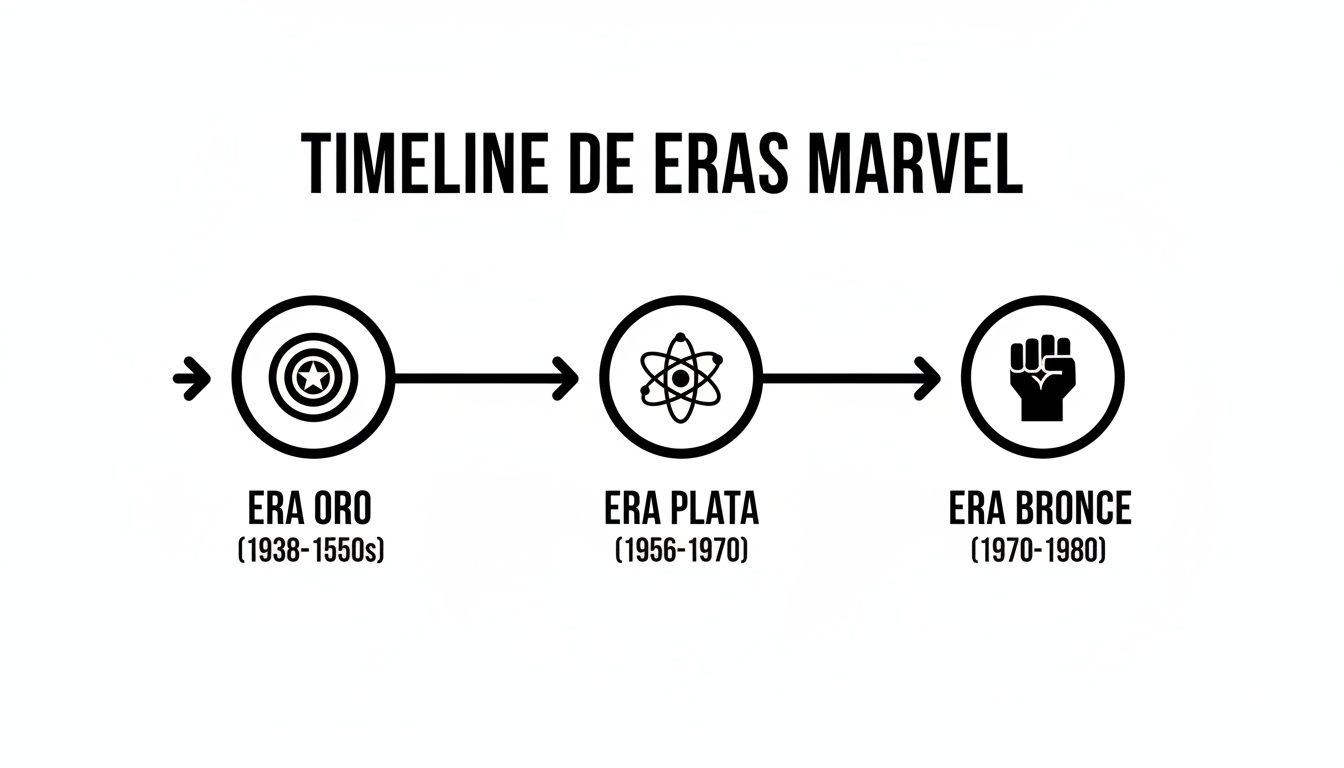
As you can see, there is a very clear progression: from the most patriotic beginnings of the Golden Age to the growing complexity of the Silver Age. All of this was laying the groundwork for the large-scale stories that would define the modern era.
If there is one event that paved the way for all those that came after, it was Secret Wars (1984). The premise was as simple as it was powerful: an all-powerful cosmic entity, the Beyonder, fascinated by humans, kidnaps a good handful of the most important heroes and villains on Earth and unleashes them on an artificial planet called “Battleworld”.
Once there, the order was clear and direct: “Destroy your enemies and all your desires will come true”. What followed was an all-out battle of epic proportions. Secret Wars was not only a sales blockbuster, but it established the formula for the modern crossover. It demonstrated that bringing together characters from different comic lines in a single saga generated a brutal impact, both narratively and commercially.
Secret Wars was Marvel’s first major “summer event”. It wasn’t a simple story; it was an editorial event that forced readers to follow multiple series so as not to miss anything, forever changing the way stories were told in comics.
From that conflict came consequences that still resonate, such as the appearance of the alien symbiote that would eventually become Venom or the prolonged absence of some members of the Fantastic Four and the Avengers from their own series.
More than twenty years later, Marvel launched what is probably its most influential event and with the greatest cultural impact: Civil War (2006). Unlike cosmic threats, the conflict here was deeply personal and ideological. An authentic civil war among the superheroes themselves.
Everything explodes after a tragedy in Stamford, Connecticut, where a fight between novice heroes and a villain causes the death of over 600 civilians, many of them children. Public opinion turns against them and the U.S. government passes the Superhuman Registration Act, a law that forces anyone with powers to register their secret identity and work as a government agent.
This law causes an irreparable split in the hero community, dividing them into two factions:
The conflict was not a simple struggle of good versus evil. Both positions had very solid arguments, which forced readers to take a stance and question their own loyalties. Civil War changed the dynamics of the Marvel universe forever, leaving broken friendships, revealed identities, and a scar of mistrust that would take years to heal. In fact, this event directly inspired one of the most acclaimed phases of cinema, and you can find spectacular designs based on the phases of Marvel movies that capture the essence of this epic confrontation.
If Civil War was an ideological war, House of M (2005) was a reality-level catastrophe. The story focuses on Wanda Maximoff, the Scarlet Witch, whose enormous powers to alter reality have spiraled out of control due to unbearable personal trauma. On the brink of collapse, Wanda remakes the entire world and creates a utopia where mutants are the dominant species and all her loved ones have the life they always dreamed of.
But of course, that perfect reality is a lie. When a handful of heroes recover their memories, they confront Wanda to restore everything to normal. Broken and cornered, she utters three words that nearly annihilate an entire species: “No more mutants”.
With that whisper, reality is restored, but with a devastating change: 98% of the planet’s mutant population loses their powers. A species of millions of individuals was reduced to just a few hundred. This event, known as the “Decimation,” became the axis of X-Men stories for nearly a decade, transforming them from a feared minority to a species on the brink of extinction.
And these are just a few examples of how major events shape the history of the Marvel universe. Sagas like Annihilation, which revitalized the entire cosmic side, or Secret Invasion, which sowed paranoia with Skrull infiltration, also left an indelible mark. In Marvel, if anything is clear, it’s that the only constant is change.
The history of the Marvel universe is not limited to a single timeline, not by a long shot. The reality that we all know as the main one, Earth-616, is just one thread in an infinitely larger and more complex cosmic tapestry: the Multiverse. Imagine an infinite number of parallel universes, each born from a different decision, where a small change in the past gives rise to a present that we wouldn’t recognize.
These alternate worlds are not mere anecdotes, far from it. They are authentic narrative laboratories where screenwriters launch themselves to explore the craziest possibilities of the “what if…?”. What would happen if a key hero had died earlier? What if the bad guys, for once, won the final battle? From these questions emerge some of the most powerful and beloved sagas by fans.
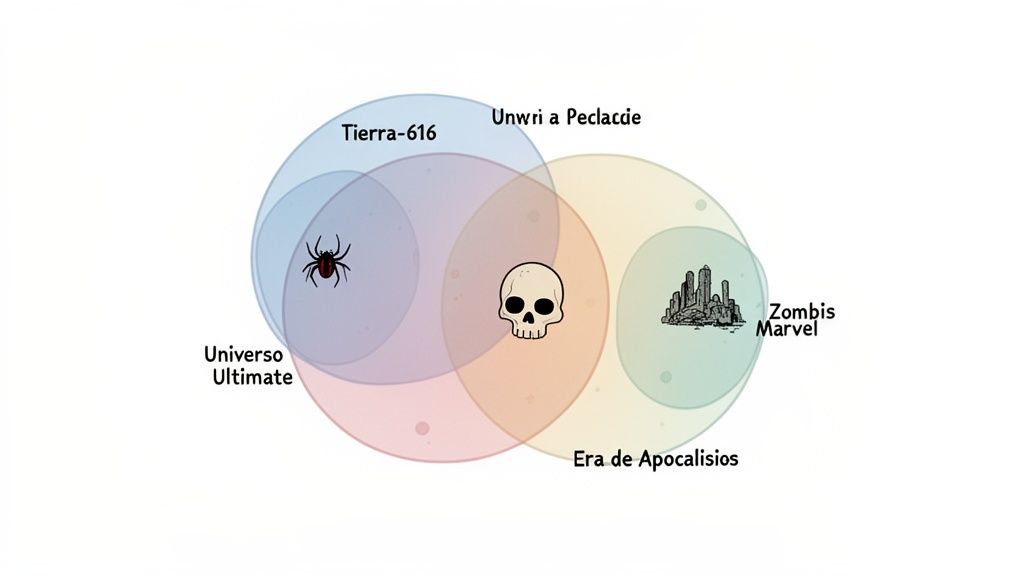
Traveling through the Multiverse allows us to discover fascinating and twisted versions of iconic characters. It enriches their mythology and shows us that heroism can flourish even in the strangest circumstances. Now, let’s take a walk through some of the most emblematic realities that have left an indelible mark on Marvel history.
Picture this: a world without Charles Xavier. On Earth-295, his unbalanced son, Legion, travels to the past to assassinate Magneto, but his father gets in the way and dies in his place. Without Xavier’s dream to guide the mutants, the all-powerful Apocalypse conquers North America and establishes a genocidal regime. Total chaos.
This event gives rise to one of Marvel’s most famous dystopias, where the heroes we know become hardened versions at the brink of desperation:
Age of Apocalypse is the perfect example of how a single change can shatter the fabric of reality, presenting a dark and hopeless world that left 90s readers speechless.
Exploring these alternate realities is not just an exercise in imagination. It is a way to understand the essence of characters by seeing how they react when everything they know is taken from them and they are confronted with their worst nightmares.
In the early 2000s, Marvel had a problem: how could they hook new readers who felt intimidated by decades of continuity? The solution was brilliant: the Ultimate Universe (Earth-1610), a parallel reality that reinvented its most famous characters from scratch for a modern audience.
This universe updated the origins and motivations of heroes like Spider-Man, the Avengers (here called The Ultimates) and the X-Men, giving them a more cinematic and raw approach. It was a huge success that gave us such influential characters as Miles Morales, the Afro-Latino Spider-Man who would later earn a place in the main continuity.
The Ultimate Universe served as direct inspiration for many of the Marvel Cinematic Universe films, demonstrating the power of reinventing classic stories.
Now, let’s move on to something more macabre. What if a virus turned Earth’s most powerful heroes into unstoppable cannibal zombies? That’s the terrifying premise of Marvel Zombies (Earth-2149). In this world, an apocalyptic outbreak infects nearly all superhumans, who retain their intelligence and their powers… but are enslaved by an insatiable hunger.
The stories from this universe are a brutal mix of dark humor and cosmic terror, showing us a Spider-Man eaten away by guilt while devouring his loved ones or a zombie Colonel America screaming “Avengers, time to feast!”. This reality is a reminder that, even in the strangest worlds, the history of the Marvel universe always finds new ways to surprise us.
Of course, here’s the section rewritten with a completely human, natural tone and following the style of the examples provided.
Don’t be fooled by the cinema craze: passion for Marvel superheroes in Spain isn’t a recent thing. It’s a love that has been simmering for decades in newsstands and bookstores across the country. The history of the Marvel universe here is almost a parallel saga, with its own heroic publishers and plot twists that have marked several generations.
This whole mess started in the 70s, a time when seeing an American comic was almost a miracle. It was Ediciones Vértice that bravely set out to bring characters like Spider-Man and the Fantastic Four. Their editions, seen today, were a wonderful chaos of cropped panels and psychedelic covers, but they were the gateway for thousands of kids.
Those Vértice publications, with their bizarre formats and translations that sometimes seemed made up, had a special charm and, against all odds, were hugely successful.
Marvel’s true golden age in Spain exploded in 1983 with the arrival of Editorial Fórum, a division of Planeta DeAgostini. Fórum didn’t just publish comics; it treated them with a respect nobody had ever seen before. They put effort into the translations, respected the original material and added mail sections and articles that created a super loyal reader community.
Thanks to Fórum, Spanish fans could experience legendary sagas almost in real time with the United States. Events like Secret Wars or Chris Claremont’s era on the X-Men became the talk of schoolyards, solidifying Marvel as part of our pop culture.
Fórum completely changed how superhero comics were seen in Spain. They stopped being a simple pastime for kids and became a respected art form, with complex stories and a universe that was crying out to be explored.
This publisher was the one that laid the foundations for collecting and proved that there was a mature audience here hungry for more.
Since 2005, it is Panini Comics who holds the Marvel rights in Spain, and they have not only continued the legacy of Fórum, but have taken it to another level. Today, getting hooked on the Marvel universe story is easier than ever, with formats for all tastes, from the classic monthly issues to luxury volumes that are a pleasure to have on your shelf.
Panini’s success has been crazy, making clear that the flame is more alive than ever. To give you an idea, the story of Marvel comics in Spain started in the 70s with Vértice, which managed to sell up to 50,000 copies. Panini has blown those numbers out of the water, exceeding 500,000 copies annually in their collections. In fact, when they launched the Marvel Library in 2022, the first issue sold out 15,000 units in weeks. It’s proof of a passion that already adds up to more than 10 million comics sold in Spain in 50 years. If you’re curious, you can check out more about this editorial journey in this detailed analysis about Marvel publishing in Spain.
Today, Marvel is a cultural monster that goes from film to series and, of course, to merchandising, like our superhero t-shirts. But we shouldn’t forget that it all started with those comic panels that, thanks to a handful of visionary publishers, crossed the ocean to stay.
Diving headfirst into the history of the Marvel universe is awesome, but let’s be honest: it can also be a monumental mess. With more than eighty years of comics behind it, with events that turn reality upside down and a chaos of parallel universes, it’s normal to end up with a bunch of questions. But don’t worry, it’s part of the adventure.
So you don’t get lost in this world of comic panels, we’ve prepared this little survival guide. Think of it as your compass to navigate Marvel’s chronology, to clear up those doubts that always linger and, once and for all, understand how the heck all the pieces of this giant puzzle fit together.
The short and simple answer is Earth-616. This is the official name of the primary reality, the setting where almost all the mythic stories you can think of have occurred. It’s the home of the Avengers, the X-Men, Spider-Man and the Fantastic Four from way back.
The term was coined by legendary writer Alan Moore back in the 80s, and Marvel eventually adopted it. Imagine that Earth-616 is the trunk of a massive tree, from which thousands of branches sprout that are the other universes of the Multiverse.
Although we’ve traveled to mind-bending worlds like the Ultimate Universe (Earth-1610) or the nightmare that was Age of Apocalypse (Earth-295), Earth-616 has always been the heart and soul of Marvel. It’s the point we always come back to.
No, not at all, and this is one of the most common confusions. The Marvel Cinematic Universe (MCU) is an adaptation, a reality completely separate from the comics. Its official designation is Earth-199999.
Although the cinema drinks a lot from the stories and characters of Earth-616, it takes a lot of liberties. This allows them to simplify decades of stories and create more direct plots for the general public. For example:
If you feel like a movie marathon and don’t want to miss any details, the best thing is to follow a specific order. For that, we’ve prepared a complete guide on the chronological order of Marvel movies that will make everything crystal clear for you.
A retcon is short for “retroactive continuity”. It’s a narrative technique that screenwriters use to change things that had already been told in the past. It’s not that they erase what happened, but rather they add new information that makes you see that old story with different eyes.
It’s used to modernize characters, fix contradictions that have come up over time, or simply to open the door to new great stories. A textbook example is what happened with Bucky Barnes, Captain America’s companion.
For decades, everyone assumed that Bucky had died in World War II. End of story. But in 2005, screenwriter Ed Brubaker pulled out a brutal retcon: Bucky survived, the Soviets found him, brainwashed him and turned him into the assassin known as the Winter Soldier. This twist didn’t eliminate his past, but made it a thousand times more interesting and led to some of Cap’s best stories.
If I’m being honest, the topic of time travel in the Marvel universe story is a mess. There’s no single rule, because each screenwriter has explained it a bit their own way over the years. However, the theory that’s used the most is that of divergent timelines.
Unlike what we see in other science fiction stories, here you can’t change the past of your own timeline. In Marvel, if you travel to the past and make an important change, what you do is create a new reality, a branch that separates from yours at that precise moment.
This is the logic that was explored in depth in sagas like Age of Apocalypse and what we’ve seen in the MCU’s Loki series. So no, killing Hitler in the past wouldn’t fix Earth-616; it would simply create a new Earth where Hitler died, while yours would stay exactly the same.
That’s the million-dollar question, and the truth is there’s no single right answer. The Marvel universe is so gigantic that the best starting point depends on what you like. Still, here are a few tips to avoid feeling overwhelmed:
The most important thing is don’t obsess over reading everything in order from 1961. It’s an impossible mission. Just pick a story, enjoy the journey, and if you like it, keep pulling the thread. Exploring Marvel is a marathon, not a sprint.
Ready to take your passion for the history of the Marvel universe to the next level? At Geek T-Shirt Store we have spectacular designs that celebrate your favorite heroes and villains from all eras. Show that you know the multiverse like the back of your hand with a t-shirt that screams your love for Marvel! Explore our complete collection at https://tiendacamisetasfrikis.com and find your next favorite piece.
Hundreds of original designs waiting for you in the store.
Join the club and we’ll email your welcome coupon right away. Original anime, gaming and comic designs.