Movies & Series15 min read
What is pop culture and why does it dominate our world
By
Published on 15 de Jun 2026
Pop culture, at its core, is nothing more than the reflection of what gets geeks excited. Think of it as all that universe of ideas, products and creations that have a major impact on society at any given moment. From the superhero movie that breaks the box office to that video game that everyone can’t stop talking about.
Far from being an academic concept for know-it-alls, pop culture is the language that we all understand almost without realizing it. It’s that song that follows you on the radio, the Netflix series that becomes mandatory conversation material or that meme that floods your social media feeds constantly.
Its magic lies in the fact that it’s for everyone. You don’t need an instruction manual or previous knowledge to enjoy it. Unlike “elite art,” no one asks you for a doctorate to play a round of Fortnite or get emotional with the latest Spider-Man movie. It’s a common playground that connects us through shared tastes and experiences.
To understand it a bit better, we can see it as a table that rests on four fundamental legs:
This explosive mix is what shapes geek culture, an ecosystem that never stops changing and reinventing itself.
Pop culture is nothing more than the mirror in which society looks at itself. It reflects what we love, what entertains us and, ultimately, what defines us as a collective in a precise moment in history.
To make it even clearer, we’ve prepared a small table that summarizes these concepts at a glance.
This table will help you get a quick and clear idea of the ingredients that make up pop culture and make it so recognizable.
| Key Element | Description | Practical Example |
|---|---|---|
| Massiveness | Reaches a global and diverse audience, without barriers. | The Star Wars saga, known and loved all over the planet. |
| Accessibility | Does not require prior knowledge to be enjoyed. | Listening to a Rosalía song or watching an episode of Stranger Things. |
| Ephemeral Character | Trends and fashions change at a dizzying speed. | The viral TikTok dance that everyone imitates for a month and then disappears. |
| Commercialization | Inspires a massive industry of derivative products. | The thousands of t-shirts, Funko figures and mugs of Harry Potter. |
As you can see, pop culture is that universal language that unites us, whether through the screen, music or a t-shirt that shouts to the world what your passion is.
To really understand what pop culture is today, you have to rewind a bit and see where all this comes from. Although we could say that things took off after the war with radio and cinema in full swing, when icons like Elvis or The Beatles demonstrated what a mass phenomenon was, the true Big Bang for geek culture was still to come.
The 80s were a brutal turning point. Suddenly, arcade halls became temples of neon lights where the gods were Pac-Man and Donkey Kong. At the same time, cinema gave us sagas like Star Wars, which not only broke the box office, but built entire universes that hooked an entire generation and defined a new way to experience fandom.
With the 90s, things got even more serious. Anime landed in the West with unstoppable force. Series like Dragon Ball Z or Sailor Moon became a daily ritual for thousands of kids. And as if that weren’t enough, the arrival of consoles like PlayStation brought the magic of arcades into the living room, changing the rules of the game forever.
This infographic sums it up pretty well: an accelerated journey from the first mass phenomena to the immediacy of the digital era.
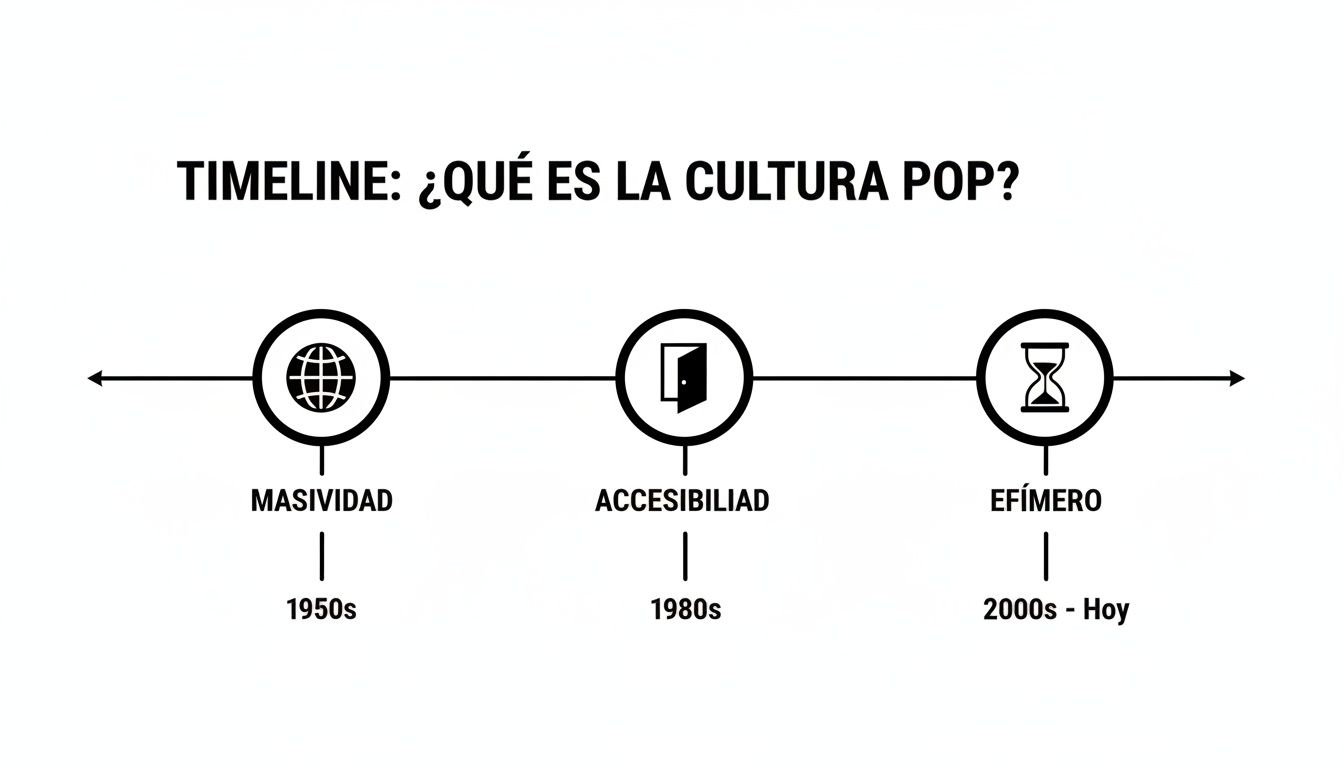
As you can see, each new technology has shortened the distance between creator and audience, making everything go faster and faster.
And so we arrived at the internet era. Social networks and platforms like YouTube or Twitch have blown down the barriers of fame. New idols no longer come only from Hollywood; now they are streamers, youtubers and viral memes that are born, blow up and, sometimes, disappear within a matter of weeks. This demonstrates the ephemeral and vertiginous character that defines current pop culture.
If you’re into seeing how one of these universes grew to become giant, check out our article on the complete history of the Marvel universe.
Not everything that becomes popular achieves the status of an icon. For a cultural product—whether it’s a video game, a movie or a series—to enter the olympus of pop, it needs a very specific combination of ingredients. It goes far beyond simply being successful.
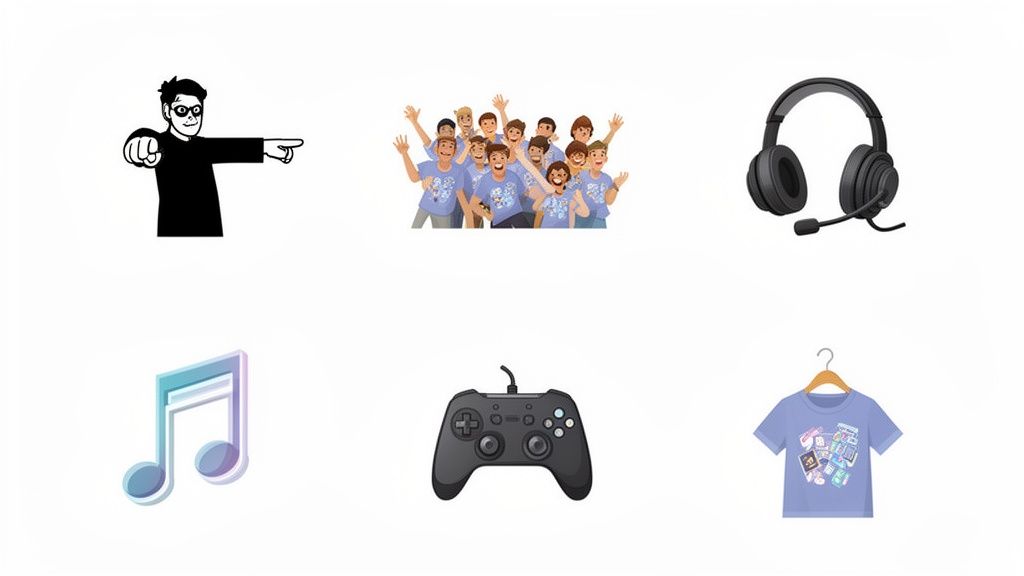
The first ingredient, and the most obvious one, is its massive and commercial character. Pop phenomena are designed from minute one to connect with millions of people. They don’t seek a small niche, but rather to become a global event that everyone can get and enjoy, regardless of where they’re from.
But the real magic that defines what pop culture is lies in its ability to create communities. A pop product is not only consumed, but lived in a group, generating a sense of belonging that is incredibly powerful.
Think about the fans of a video game. They don’t just play and call it a day. They gather in forums to debate theories, go to massive conventions like Comic Con to meet the creators and, of course, wear t-shirts of their favorite characters as a statement of principles.
A perfect example is how League of Legends has gone far beyond the game itself. Riot Games has built an expanded universe that includes:
Pop culture succeeds when it manages to transform the audience from being a mere spectator into an active participant, a proud member of a global tribe.
Another textbook case is Deadpool. The guy breaks the fourth wall constantly, speaking directly to the audience with sharp and self-aware humor. This direct connection made him a cultural reference instantly, because it felt close, like a colleague telling you a joke, transforming a movie into a shared experience.
Here in Spain, pop culture is not something that is simply consumed, it is something that is lived intensely, especially when there is live music involved. Festivals and concerts have become authentic rituals, that meeting point where thousands of fans come together to celebrate their passion for all kinds of genres, from timeless pop rock to the urban rhythms that are killing it right now.
But watch out, these events are much more than just a weekend plan. They function as a brutal economic and cultural engine that sets the rhythm of what is trending. In fact, live music consumption has seen an impressive surge, to the point of becoming a pillar of what pop culture is in our country. In 2023, things skyrocketed to 28.3 million attendees, the highest figure since 2011, with Spanish pop rock taking the crown with 40.5% of the audience. If you want to dig deeper, you can check out the analysis on music consumption in Spain.
All that passion that overflows at concerts and other cultural phenomena doesn’t stay there, it jumps straight onto the pavement. You see it in urban fashion and, of course, in merchandising. A t-shirt from your favorite band, from that video game that blew your mind or from the movie that marked you is no longer just clothing.
It is a statement of intent, a symbol of identity and a way to connect with others who share your same passions.
Wearing a t-shirt of Zelda or your favorite artist is like carrying a banner. It functions as a visual code that identifies you instantly as part of a community, of an urban tribe that moves by the same tastes. Thus, fashion becomes the perfect canvas where pop culture paints itself daily, showing the world who you are without having to say a single word.
If radio and TV once set the pace, today the true engine of pop culture is streaming platforms. Spotify, Netflix or Twitch are no longer mere content distributors; they create it, push it and turn it into a global phenomenon in a matter of hours. They are the new Midas kings that dictate what is heard, what is seen and even what is talked about at the dinner table.
The craziest case is music. Urban genre dominates the charts with crushing authority, and a large part of the blame lies with the virality of platforms like TikTok. There, a catchy 15-second hook can catapult a song to worldwide stardom overnight. On this new playing field, streaming music is the absolute queen.
Streaming has blown up the borders. It is no longer just about listening to a song or watching a series; it is about participating in a global cultural conversation that is born, grows and multiplies on these platforms.
This domain is especially brutal in Spain. In 2023, Spaniards listened to an average of 21.6 hours of music per week, where streaming took 86% of the pie. And pay attention to this: 70% of the most popular songs belonged to the urban genre. You can read more about the new challenges for music in Spain to be amazed by the figures.
But that’s not all. The boundaries between the geek world and more commercial music are increasingly thin, almost invisible. A textbook example is seeing how video game soundtracks, like that of Cyberpunk 2077, or successful anime series, become real hits on Spotify, accumulating millions and millions of plays.
And then we have phenomena like Stranger Things, which rescues 80s bangers from the vault of memories and puts them back at the top, proving that nostalgia is a superpower. If you want to better understand this impact, don’t miss our article on Stranger Things merchandising. Thus, today’s pop culture unapologetically mixes the most modern rhythms with your favorite video game soundtrack.
Pop culture no longer settles for staying on screen; it has jumped into the real world to become an experience we live as a community. It’s no longer just about watching a series alone or playing a video game. The real magic now is in sharing that passion, in those collective rituals that unite us.
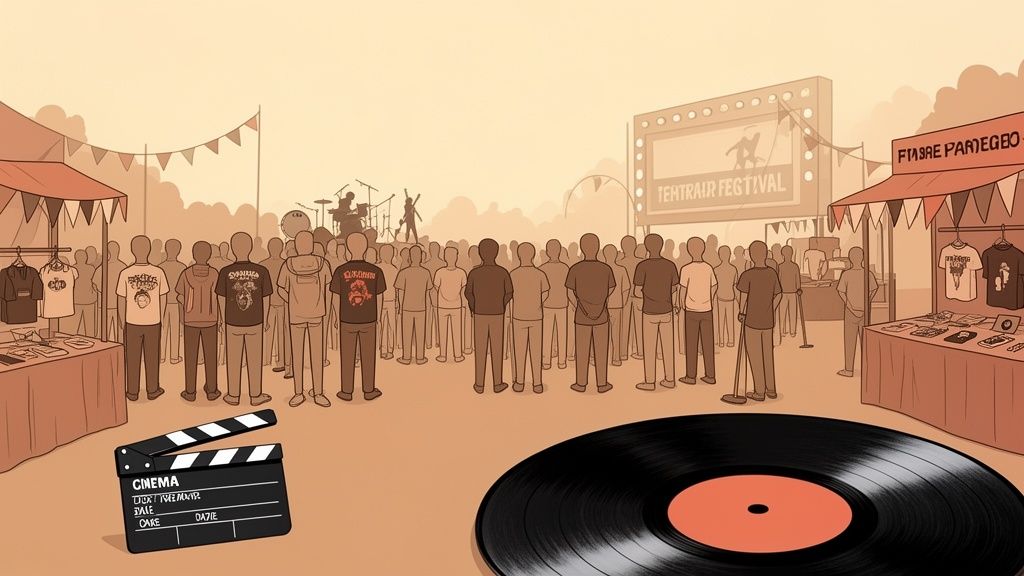
Going to a Marvel movie premiere or a music festival has become a full-fledged social event. Merchandising, like wearing a t-shirt of your superhero or favorite band, works as a signal of identity, a way of saying “hey, I’m also part of this tribe” without needing to say a word.
This need to touch and experience pop culture is perfectly reflected in the figures. Attendance at shows and cinemas is having a golden moment in Spain, with almost half the population signing up for these plans. 48.8% went to the cinema, and 48.3% to concerts or performing arts. You can see more data about the cultural habits of the Spanish population.
In a world that seems to become more digital every day, pop culture gives us a dose of reality and reminds us of the power of the physical and being together, turning individual consumption into a shared celebration.
This phenomenon leaves us with a fascinating duality. While the digital advances at full speed, physical formats with a retro flavor like vinyl are experiencing a second youth. Although the physical music market in general is declining, vinyl sales got a boost of 15%. Absolutely amazing.
This demonstrates that, in the pop culture ecosystem, what is for the masses and what is niche not only coexist, but they feed off each other. They create a universe full of contrasts, rich and, above all, very much alive.
To finish tying up all the loose ends, we’re going to resolve those doubts that always come up when we try to define what pop culture is. Here you have direct answers to those questions that, for sure, you’ve asked yourself at some point.
Think of it this way: pop culture is the main stage of a giant music festival, the one where the bands that everyone knows play. The movies, music and series that most people consume are there. Geek culture would be one of the themed stages of that same festival, a smaller one specialized in niches like anime, superhero comics or role-playing games.
What’s interesting is that sometimes a band from that themed stage becomes such a hit that it ends up jumping to the main one. That’s exactly what happened with Marvel characters or sagas like Star Wars, which went from being a niche phenomenon to completely dominating popular culture worldwide.
Totally. In fact, memes are one of the best examples of what pop culture is in its purest state: digital, massive and super-accelerated. They spread at lightning speed, their lifespan is usually short and they are a perfect reflection of the humor, ideas or obsessions of a society at a very specific moment. A meme that goes viral is a pop micro-phenomenon in every way.
Understanding pop culture is, at the end of the day, a way of understanding the world around you. It’s like a mirror that shows us what things we value as a society, what worries us and how we communicate. It’s not trivial; it’s a brutal engine of creativity and connection that influences everything, from the fashion you see on the street and the words you use to the technology you carry in your pocket.
If you want to take your passion for pop culture to the next level, check out the incredible collection of t-shirts we have at Geek T-Shirt Store. I’m sure you’ll find that design that represents you to dress your geekiest side! Visit our online store and discover your next favorite t-shirt.
Hundreds of original designs waiting for you in the store.
Join the club and we’ll email your welcome coupon right away. Original anime, gaming and comic designs.