Sin categoría8 min read
What does kitsune mean and why is its mask everywhere
By
Published on 15 de Aug 2026
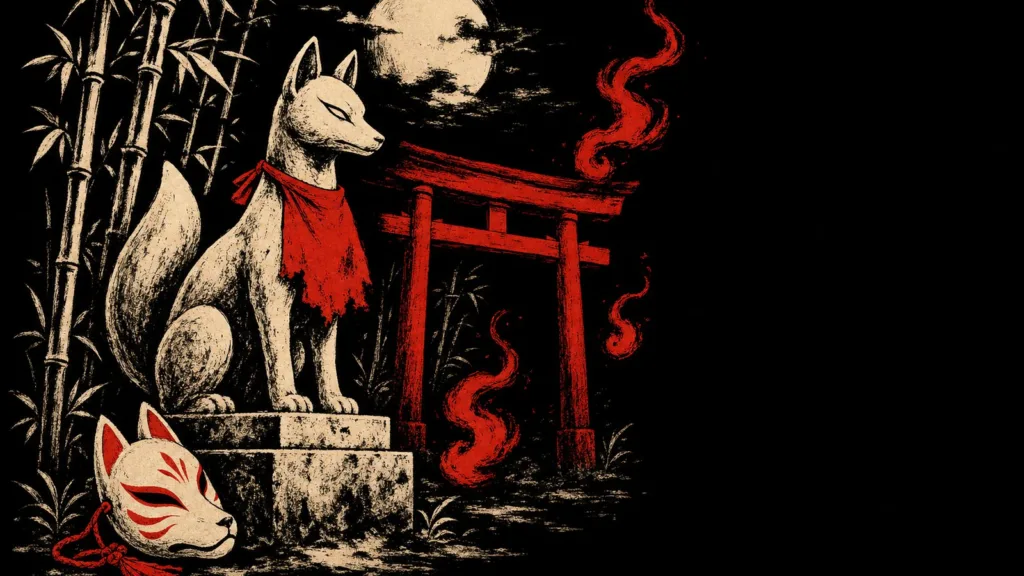
The fox appears throughout Japanese visual culture: on t-shirts, on posters for autumn festivals, on the door of any noodle shop. What kitsune means can be summed up in a short sentence, the messenger of the rice god who wears a white mask, but that definition falls short right away. Under that label coexist a guardian faithful to a shrine and a spirit that deceives for sport, two opposite personalities trapped in the same animal. That contrast explains why its face keeps appearing on posters, mugs and t-shirts long after ceasing to be just a rural cult figure. Understanding that tension is the only way to know why people keep drawing foxes with nine tails.
In Japanese, kitsune simply means fox. The word does not distinguish between the wild animal that scurries through the forest and the supernatural creature of legends, so context does all the work. Within Shintoism, a specific class of foxes serves Inari, the deity of agriculture, rice and commercial prosperity. Those benevolent foxes are called zenko and act as guardians and messengers of the god in each shrine that bears his name. Their stone statues flank the entrance of those sacred spaces with a granary key, a gem or a scroll held between their teeth. None of those statues are mere decoration: each one marks the point where a god’s territory opens to the human world.
A young kitsune is born with a single tail, like any common fox. Over the centuries, new tails grow, and each added tail marks a leap in wisdom and magical power. Nine is the maximum number it can reach, and getting there means the animal has been alive for more than a thousand years. A nine-tailed kitsune masters transformation, controls the will-o’-the-wisp that stories call kitsune-bi and perceives things that escape human senses. Reaching that final tail is not automatic: it demands centuries of correct behavior, because a fox that abuses its magic gets stuck forever. That’s why stories treat tails like a visible resume, something any other spirit can read at a glance.
The zenko serve Inari with loyalty and protect the rice crops of an entire village. Opposite them are the nogitsune, wild foxes that act on their own and enjoy deceiving humans. A nogitsune disguises itself as a wandering monk, a respectable old man, or a beautiful woman to slip into someone’s life and take advantage of them. The legend of Kuzunoha tells the most cited case: a fox takes the form of a woman, marries a man, has a son with him, and leaves as soon as her true nature is discovered behind a paper screen. Rural folklore added another layer to this mistrust with kitsune-tsuki, the belief that a fox could possess a person (almost always a young woman) and slip under her nails to feed on her energy. Whoever suffered that possession, according to the neighbors’ accounts, would act erratically and devour enormous quantities of tofu, the animal’s favorite food. Even the weather enters the myth: when it rains with the sun shining at the same time, tradition calls this phenomenon kitsune no yomeiri, the fox’s wedding, because it was believed that the bride and groom summoned the rain so that no one would spy on the ceremony. This crossing between the domestic and the inexplicable sums up the kitsune quite well: you never know if you have before you the guardian of the harvest or the spirit that is going to laugh at you.
Kyoto guards the shrine that best sums up this relationship between the fox and its god. Fushimi Inari Taisha was founded in the year 711 and remains the headquarters of a network that includes more than 30,000 shrines dedicated to Inari throughout Japan. Climbing to the top of its sacred mountain involves crossing more than 10,000 vermillion-painted torii gates, placed one behind the other by donations from grateful merchants and families. This journey through a wooden tunnel has its own separate explanation in what the Japanese torii means, the gate that separates the sacred from the everyday. Among these gates stone foxes appear everywhere: sitting, standing upright, with a key or gem between their jaws. No visitor walks more than a couple of minutes without crossing the fixed gaze of a kitsune watching over the path. That same spirit of silent guardian reappears in other figures of the Japanese shrine, something that becomes noticeable when browsing the complete catalog of Japanese art motifs that surround the same temples and legends.
Wearing that fox face is not a recent invention of any costume shop. Kyogen theater, the comedic cousin of Noh theater, has included the kitsune mask as one of its basic pieces for centuries, with the face painted white and red strokes around the eyes and snout. The kagura dances of Shinto shrines use the same resource: whoever puts on the mask stops representing just an actor and begins to embody Inari’s messenger on stage. The white face evokes the fur of the sacred fox, while the red recalls the color of the torii that form the path to the shrine. Just as with the oni mask, the physical object transforms an abstract idea into something that can be touched, stored in a drawer, and taken out again each year.
Tokyo preserves a modern version of that ritual that deserves separate mention. Every New Year’s Eve, the Oji neighborhood recreates the legend according to which foxes from all over eastern Japan would gather beside a sacred tree before proceeding in procession to the local shrine to make their first visit of the year. The current parade, called Oji Kitsune no Gyoretsu, started in 1993 taking as a model a print by painter Hiroshige, and brings together about 300 participants each year dressed in traditional clothing and fox mask, carrying yellow paper lanterns that evoke the will-o’-the-wisp of the legend. Seeing that row of identical masks pass by in the light of the lanterns explains better than any text why the kitsune’s face continues to travel outside the shrine, the forest, and the theater to settle into today’s popular culture.
I like to think that mask functions as a physical reminder of a very old idea: the kitsune lives on the border, neither completely in the forest nor completely in the village, neither completely animal nor completely divine. Putting on its face for one night means peeking for a while at that in-between territory and coming back with a clearer head. You don’t need to believe in nine-tailed foxes to recognize that gesture: leaving home, crossing any threshold, and disconnecting for a couple of hours from the usual noise continues to be, centuries later, the simplest way to feel that you’ve changed worlds for a while.
It depends on the fox. The zenko serve Inari and protect harvests, homes, and businesses, so tradition treats them as allies. The nogitsune act freely and seek to have fun at humans’ expense, although they rarely cause real harm. That dual nature is precisely what makes the character interesting: there’s never a single label that applies to all the foxes in the myth.
Each new tail marks an increase in age and magical power. A fox newly arrived in the supernatural world has only one tail, and only after centuries of existence does it manage to add more. Reaching nine tails transforms the kitsune into an almost omniscient spirit, capable of controlling will-o’-the-wisps and reading others’ intentions effortlessly.
It continues to appear in Kyogen theater, in kagura dances at shrines and in popular parades such as the one in Oji, Tokyo, during New Year’s Eve. It is also a regular part of autumn festivals dedicated to Inari, where children and adults wear it with no other intention than to participate in the neighborhood celebration.
Hundreds of original designs waiting for you in the store.
Join the club and we’ll email your welcome coupon right away. Original anime, gaming and comic designs.