Sin categoría9 min read
What does the oni mask mean and why does it protect instead of scare
By
Published on 18 de Aug 2026
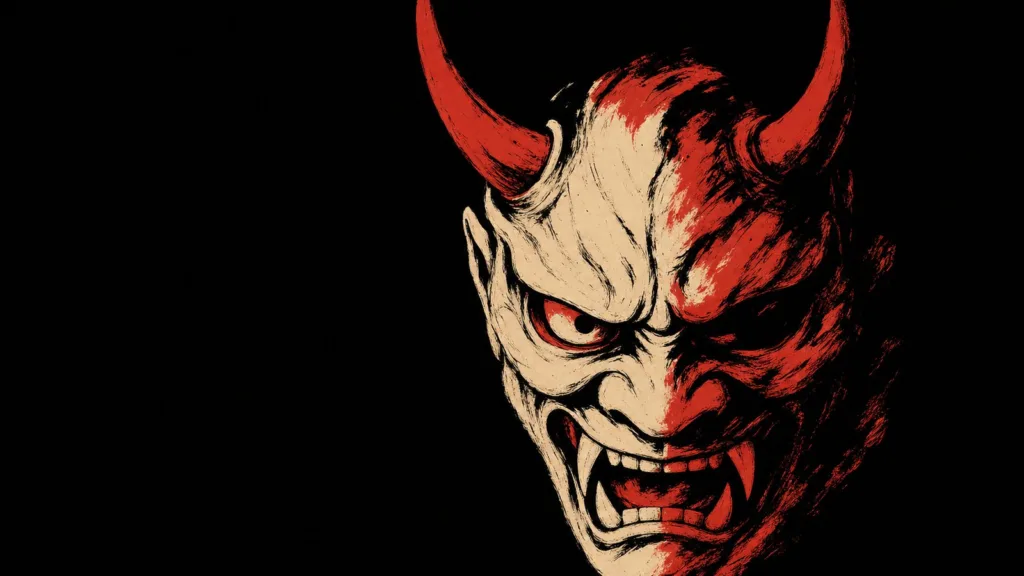
A red-skinned face, curved horns pointing backward, and an open mouth with fangs: this is how almost everyone imagines the oni, the demon from Japanese folklore. Its mask appears at neighborhood festivals, in wooden carvings, and in the corners of some roofs. That’s where the surprise begins, because that monster face isn’t made to invoke evil. It’s made to drive it out of the house.
The tradition of Setsubun explains this paradox better than anything else. A family member puts on the oni mask, plays the role of demon for an afternoon, and the rest of the house throws roasted beans at them until they reach the door. The gesture doesn’t seek to frighten for the sake of frightening. It seeks to mark, with absolute clarity, who stays inside and who goes outside. That same principle repeats on temple roofs, in winter visits from Akita, and in a large part of Japanese imagination, where the fierce almost always ends up protecting something.
The word oni didn’t always name a horned monster. Originally it referred to the hidden, to what is unseen, and was written with a Chinese character that represented the body of a deceased person placed for burial. Over the centuries, that character came to designate both the spirits of ancestors and hostile forces from beyond the grave. During much of ancient Japanese history, any ghost, minor god, or strange creature could be called oni without distinction.
The features we associate with the word today (the horns, the tiger skin as a loincloth, the iron club) were gradually fixed over time. Horns don’t appear consistently until the Konjaku Monogatari, a collection of Buddhist tales from the 12th century. The combination of horns and tiger skin alludes to the kimon, the northeast direction of the Chinese calendar, located between the signs of the ox and the tiger: the gate through which, according to that cosmology, evils entered. The red and blue of many masks also comes from this, borrowed from Buddhist guardians known as yaksha.
That boundary between the ox and the tiger isn’t so different, in the end, from other thresholds in Japanese imagination. The torii that separates the everyday from the sacred fulfills a similar function without needing a fierce face to achieve it. Whoever wants to delve deeper into that other symbol can read what the Japanese torii means and compare the two languages: one threatens to protect, the other delimits in silence.
As the centuries passed, the oni also became a label for the foreign. Medieval texts describe foreigners arriving by ship as oni, people with some disability, or simply anyone who didn’t wear their hair in the style prescribed by social norm. The mask, then, did two jobs at once: it was the demon from the story and, in more than one case, it marked whoever fell outside the group.
Every year, around February 3rd, Japan celebrates Setsubun, the change of season that marks the farewell to winter in the traditional calendar. The central ritual is called mamemaki, the throwing of roasted soybeans. One family member covers themselves with the oni mask and goes to the door. The rest of the house throws the beans at them while shouting Oni wa soto, fuku wa uchi: out with the demon, in with fortune.
This custom came from Chinese purification rituals and became established as a Japanese popular tradition from the 17th century onwards. Eating as many beans as years you have lived, placing a roasted sardine head next to a sprig of holly at the entrance, or preparing a sushi roll that is eaten in silence while looking towards a specific point: all of that is part of the same day, but the heart of Setsubun remains the mask and the gesture of expelling it.
Some temples, like Naritasan Shinshoji, change the formula and only shout “in with fortune,” without mentioning the demon. The reason they give is curious: they believe their guardian deity is compassionate enough to welcome even a repentant oni. That exception confirms the rule of the rest of the country. The mask exists to mark an exit, not a welcome.
No one who participates in mamemaki truly believes that a demon roams their house. What is expelled, in practice, is the bad luck of the year beginning, illness, unnamed misfortune. The mask puts a face on something that would otherwise be abstract, and that’s why it’s easier to point a finger at it and throw it out the door with soybeans.
In many temples and traditional houses, a demon’s face tops the ridge of the roof. They are called onigawara, literally “oni tiles,” and they perform two different jobs. The first is technical: they channel rainwater and seal the joint of the tiles so that moisture doesn’t seep in. The second is symbolic: that fierce grimace looks outward, toward the road, and is supposed to block the way to whatever brings misfortune before it reaches the door.
The first onigawara date from the Asuka period, when Buddhist roofs began to incorporate decorative motifs at their ends, although back then the most common drawing was a lotus flower and not a demon. The fierce face as a dominant motif came later, around the Kamakura period, and since then its function has barely changed: watch outward, protect inward.
Someone living under a roof with onigawara doesn’t feel threatened when looking at it. Rather, they feel that someone is watching over them while they sleep. That feeling, in my view, summarizes well the role of the oni in Japanese culture: the face that scares is not meant for whoever lives inside the house, but for whatever tries to enter.
In the Oga Peninsula, in Akita Prefecture, the tradition of wearing an oni costume takes things a step further. Every December 31st, young unmarried men from the village put on demon masks—one red and one blue or green—cover themselves with straw capes called mino, and go around the neighborhood houses armed with wooden knives. They enter shouting, ask if there are lazy or disobedient children in the house, and with that question, they fulfill their purpose: reminding everyone, big and small, that they must work and behave well.
The inhabitants of Oga themselves do not consider the namahage to be evil beings. They see them as messengers of the mountain gods who bring protection against natural disasters, illnesses, and poor harvests. The first written record of the custom appears in 1811, in a book by traveler and ethnographer Masumi Sugae. Japan declared it an Important Intangible Cultural Property in 1978, and UNESCO added its own recognition years later.
The kitsune fox, another recurring inhabitant of the Japanese imaginary, lives a similar ambiguity: faithful messenger at a shrine, trickster in the next story over. Those who want to pull on that thread can read what kitsune means in Japanese tradition and confirm that the boundary between the fearsome and the protective is rarely fixed.
There is something about mamemaki that goes beyond folklore. Once a year, an entire family has explicit permission to yell at someone, throw things at them, and kick them out of the house amid laughter. Psychology has been debating for decades whether venting anger really calms it down, and much recent research suggests that shouting or hitting something without further context tends to fuel anger rather than extinguish it. What does seem to hold up better is the ritualized version of the release: a defined moment, shared with family, with a clear beginning and end.
I think that’s where the true value of Setsubun lies, beyond the joke with the beans. Throwing legumes at a costumed relative won’t magically cure the bad mood accumulated in January. That day gives permission to let it out in front of others, without anyone taking it personally, and that collective permission weighs more than the gesture itself. Losing your temper once a year, masked and in company, works better than holding it in for three hundred and sixty-five days straight.
That gesture of the oni mask, after all, isn’t so far from other symbols that decorate a house to divert bad luck elsewhere: guardian gates, protective animals, faces that watch without harming whoever lives behind them. That visual language runs through much of Japanese art and explains why so many fierce figures end up protecting, instead of attacking, those who have them close by.
It depends on the narrative. In folk tales and in paintings of Buddhist hell, the oni punishes and torments guilty souls. In Setsubun and in namahage, on the other hand, it functions as a corrective or protective figure: it frightens to maintain order, not to cause real harm. The Japanese oni never had a single fixed meaning. It changes depending on the ritual and the era in which it is told.
The horns became popular due to the association of the oni with the kimon, the northeast direction located between the signs of the ox and the tiger in the Chinese calendar. This is also where the tiger skin that the figure usually wears as a loincloth comes from. This image stabilized around the 12th century, with works like the Konjaku Monogatari.
The most widespread interpretation, linked to Setsubun, associates each color with one of the five Buddhist obstacles: red with greed, blue with anger, green with laziness, yellow with restlessness, and black with doubt. This interpretation is not universal nor is it applied equally in all regions, but it explains why red and blue are, by far, the most common colors.
Hundreds of original designs waiting for you in the store.
Join the club and we’ll email your welcome coupon right away. Original anime, gaming and comic designs.