Sin categoría9 min read
What does the Japanese torii mean and why does it appear everywhere
By
Published on 14 de Aug 2026
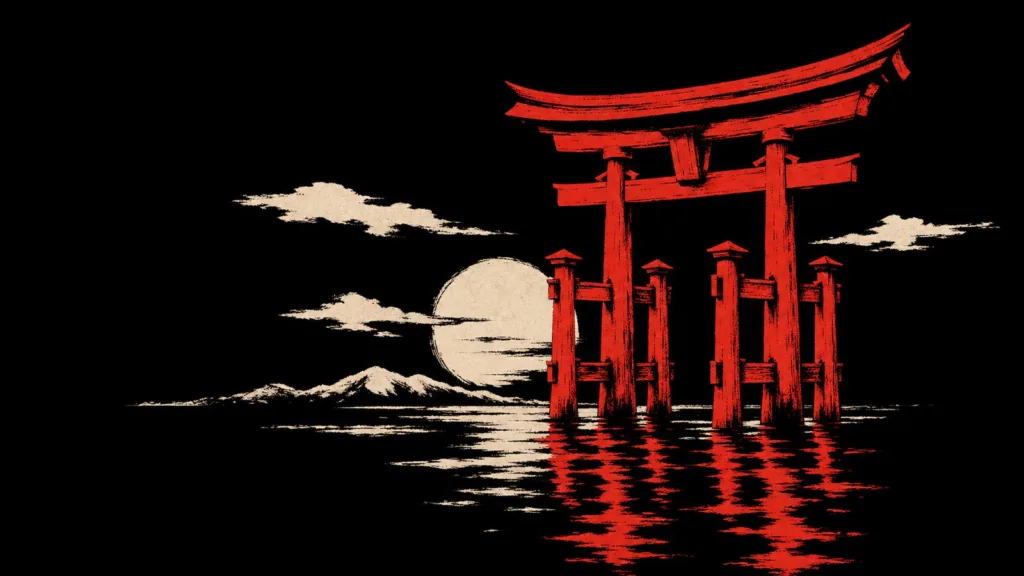
A torii is an arch: two vertical posts hold one or two horizontal crossbeams, almost always painted in vermillion, and this simple framework has been marking the entrance to Japan’s sanctuaries for centuries. Whoever crosses it does not pass through a door with shutters that close, but a threshold without lock or bolt. The gesture matters more than the object itself. This simple idea explains why this symbol is recognized at first glance, whether someone has set foot in Japan or not.
What the torii means has a short answer: it marks the boundary between the world of people and the territory of the kami, the spirits of Shintoism. In this religion there is no physical border between the sacred and the everyday, so a symbolic warning is needed, and that warning is the torii. Crossing it is equivalent to a small ritual of attention: slow down, walk along the sides of the path (the center is reserved for the kami themselves) and enter a space where the rules change slightly. No torii physically blocks the way. It can be walked around, jumped over, ignored without effort. But almost no one does it, because the arch works as a reminder, not as a wall. A temple may have just one at the entrance to the grounds or several staggered, each marking a different level of proximity to the sacred.
The word is divided into two parts with their own reading: tori, bird, and i, to perch or inhabit. Torii would then be “where birds perch,” and this etymology fits with a very repeated legend about the sun goddess Amaterasu. The myth tells that Amaterasu locked herself in a cave and left the world in darkness, and that the other gods gathered roosters so they would sing and make her come out with their call. The torii, in this reading, would be the roost where those birds placed themselves to call her. No one can fully confirm the real origin of the structure, and that’s what’s interesting: some authors relate it to the torana, the ceremonial arch that arrived from India along with Buddhism; others link it to Chinese pailou, commemorative porticos of similar shape. Both theories coexist without it being resolved which carries more weight, and that uncertainty has bothered no one in Japan for centuries: the symbol works the same way, no matter how it is explained.
There are two main families. The first, shinmei, is built only with straight lines: a straight upper crossbeam, two posts and a connecting bar, with no curves or ornaments. It is considered the oldest and also the most austere style. The second family, myojin, incorporates an upper crossbeam curved upward at the ends, which gives it a lighter and more decorative air, and usually appears in larger sanctuaries. Within myojin there are regional variants, such as the kasuga torii, with a straight crossbeam but posts topped differently.
Nor is the color a matter of chance. Traditional vermillion doesn’t just seek to attract attention: it is believed to protect the wood from moisture and the passage of time, and at the same time ward off evil spirits, a symbolism associated especially with sanctuaries dedicated to the god Inari. Fushimi Inari, in Kyoto, is the most photographed example, with a path that climbs the mountain and brings together about 10,000 torii donated by merchants and families since the Edo period, each one as thanks for a fulfilled wish. Next to those arches, stone foxes keep watch, the kitsune, considered messengers of Inari himself. Throughout Japan there are more than 80,000 registered Shinto sanctuaries, and practically all of them share this same entrance element, although the size and material vary from one to another.
The material also varies depending on the era and budget of each sanctuary. Wood was the original choice, but it rots with the humidity of the Japanese climate, so many modern torii are built in stone, reinforced concrete, or even steel painted to imitate the appearance of traditional lacquer. Sanctuaries with more resources maintain the wood and repair it every few decades, an expense they assume with pride because it is part of the ritual. The more modest ones, on the other hand, opt for materials that don’t require constant maintenance, and no one considers that to detract from the spiritual value of the arch. Fushimi Inari, dedicated to the god Inari since the year 711 of our era, is the head sanctuary of more than 30,000 temples that venerate this deity scattered throughout the archipelago, proof of how widespread this particular cult is within Shintoism.
Before reaching the main building of a sanctuary, the visitor usually finds a stone fountain called temizuya, designed for washing hands and rinsing the mouth before moving on. The gesture comes from ancient times: water purifies, and that previous step prepares the person to cross the torii with clean hands, in the literal sense. Already inside the grounds, two stone figures usually watch over the path on both sides, the komainu, shaped like a lion and dog at the same time, one with its mouth open and the other closed. No one demands following these steps to the letter, and a good part of tourists ignore them without anything happening. But whoever takes the minute to stop at the temizuya and make a slight bow before passing under the arch notices a real difference in how they experience the place, even if they don’t profess Shintoism or understand a word of Japanese. Large sanctuaries don’t settle for one torii at the entrance: they usually place other smaller ones along the path to the inner sanctuary, and each one marks a different degree of closeness to the sacred, like layers of the same idea repeated.
If the classic torii has a postcard version, this is it. On the island of Miyajima, off the coast of Hiroshima, the Itsukushima Shrine raised its first torii around the year 1168 by order of the nobleman Taira no Kiyomori. The structure has been rebuilt several times since then: it fell, it burned, it was replaced, and the version seen today, the ninth, was completed in the year 1875 and measures 16.8 meters in height and weighs about 60 tons, and it has no foundations under the water: it stands by its own weight alone, driven into the sandy bed of the bay. At high tide it seems to float on the sea; at low tide, people walk up to it and touch the wood. That contrast, water and earth in the same place depending on the time of day, makes Miyajima one of the most visited sites in Japan, and to me it seems the perfect example of how an object of wood and lacquer can summarize an entire religion without needing a single written word.
The Itsukushima complex was added to the Unesco World Heritage List in the year 1996 and underwent a thorough restoration between 2019 and 2022: repair of termite damage, ultraviolet-resistant paint and structural reinforcement with steel bands and carbon fiber, all designed so the sea continues unable to overcome it. The scene recalls other water landscapes very present in Japanese symbolism, such as ponds with koi carp that border the gardens of many temples, although the Miyajima torii plays in another league for size and history.
The silhouette of the torii has made the leap from shrine to screen without losing a single feature. Two posts and a crossbeam are summed up in very few pixels, so it results in a grateful icon for any minimalist design, from a logo to a tourist map. In the retro aesthetics of eight or sixteen bits, that same shape is often used to mark a save point or a place of rest within a level, a visual nod to the original idea: a place where the player stops, breathes and decides whether to continue forward. The form doesn’t change, the context changes, just as it happens with other symbols that have traveled that same path, like the maneki-neko that waves from the window of any store. That ability to travel between a centuries-old wooden temple and a mobile phone screen says quite a bit about how well designed the symbol is from the beginning: few lines, much meaning, zero need for text.
Outside of video games, the same arch appears on station posters, hiking maps and even in the most contemporary Japanese art, where traditional ink and geometric stroke coexist. The reading does not vary: threshold, transit, a before and after marked with two posts and a line on top.
It marks the entrance to a sacred space within Shintoism. It doesn’t close off the passage or act as a physical door: it warns that, from that point on, the visitor enters the territory of the kami.
Vermillion is traditionally associated with protection against rotting wood and evil spirits, especially in shrines dedicated to the god Inari. Not all torii gates are painted this color: there are unpainted stone ones, metal ones, or natural wood ones, depending on the shrine’s tradition.
Yes, any visitor can pass under a torii gate without practicing Shintoism. Custom dictates walking to one side of the path and making a small bow before entering, a gesture of respect rather than a religious requirement.
Hundreds of original designs waiting for you in the store.
Join the club and we’ll email your welcome coupon right away. Original anime, gaming and comic designs.