Gaming20 min read
Practical guide to gaming and office mouse pads
By
Published on 15 de Jun 2026
Detecting the ideal surface makes the difference between a cursor that glides effortlessly or one that gets stuck on every click. With quality mouse pads, that transition is so smooth you almost forget that keys exist. Whether in intense matches or work marathons, this small detail optimizes your precision and comfort.
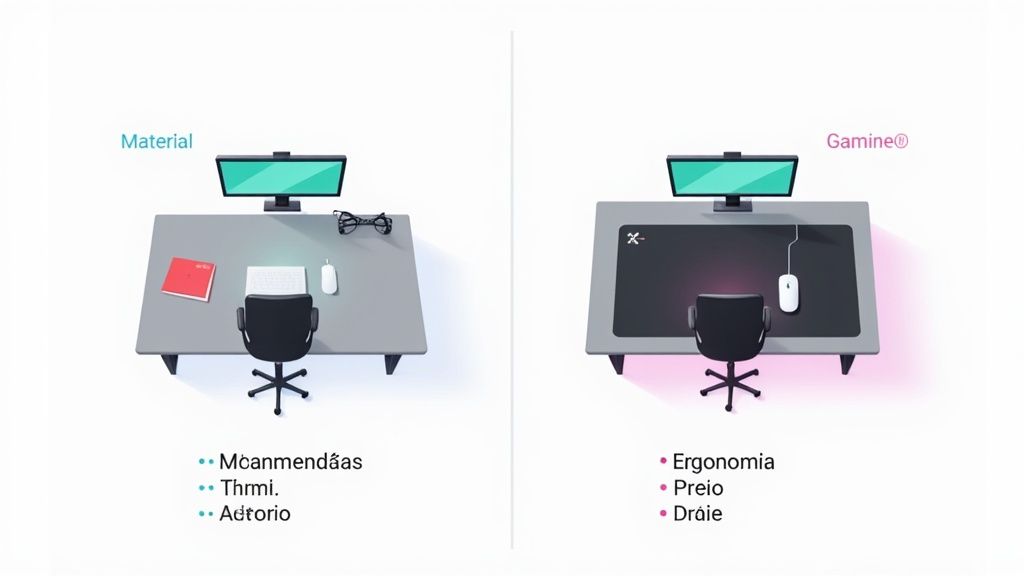
A good mouse pad works as a stable and even foundation.
By smoothing out irregularities, the sensor doesn’t lose track of your movements.
| Factor | Brief Definition |
|---|---|
| Material | Friction and durability |
| Size | Usage space |
| Ergonomics | Comfort and support |
| Price | Value for money |
Each user has different priorities depending on their activity. In gaming, low-friction surfaces are sought for agile movements. In the office, smoothness and support during long workdays take priority.
"A simple change can transform your space and elevate your performance."
For example, a streamer improved their aim by 20% after switching to rigid rubber. Similarly, a company reduced wrist injuries by offering ergonomic mouse pads to its staff.
Learn more about hardware and peripherals in our computer guide.
This overview sets the stage for exploring each factor in detail.
In a minimalist office setup, switching to a soft textile mouse pad reduced wrist tension. The added support allowed for increased productivity without sacrificing comfort.
A professional player adopted a rigid aluminum model to achieve more precise strokes. His aim improved noticeably in first-person shooter titles.
This introduction paves the way for the details.
When you slide the mouse over a mouse pad, three elements make the difference: friction, texture, and thickness. Each one acts like the terrain of a race, defining how much force you need and how the cursor behaves.
Friction measures resistance to movement; imagine skating against the wind. Texture is the relief that guides or slows your pointer, like a smooth road or one full of potholes. Thickness provides cushioning and comfort, preventing direct contact with the desk.
To visualize it, think of these scenarios:
Optical sensors detect minimal surface irregularities, almost like reading relief in low resolution. Laser, on the other hand, penetrates deeper and picks up fine details of the structure.
For example, a thin mousepad can accelerate mouse response by offering less cushioning between the sensor and the desk.
| aspect | optical | laser |
|---|---|---|
| detection | minimal detail | fine detail |
| compatibility | works well on fabric | optimal on hard materials |
A uniform surface avoids cursor jumps. If the terrain varies, you have to readjust DPI and sensitivity to regain precision. With a consistent base, calibrating becomes much easier.
Fine-tune your aim by combining broad and fine movements until you find the sweet spot. Start with low DPI and increase it gradually.
Follow these steps to optimize your setup:
A uniform surface accelerates your aim without extra effort.
That simple insight makes the difference in gaming and office work.
Beyond theory, practice is your best ally. Try different thicknesses and textures according to your gaming or work style.
Thickness factors to consider:
Practical selection cases:
| surface | friction | comfort |
|---|---|---|
| textile fabric | medium | high |
| rigid rubber | low | medium |
| smooth aluminum | minimal | low |
Each combination offers pros and cons. Choose according to how you move your mouse and how many hours you spend in front of the screen.
The best mousepad is the one that adapts to you. A frantic gamer will appreciate the faster glide, while an office professional will value the cushioning and constant support.
Your real experience is the definitive indicator. With these clear principles, your next purchase will be much more conscious and satisfying.
To determine the ideal mousepad, you first need to understand how each material influences your experience when moving the mouse. Below we will explore the advantages, sensations and costs of the most popular types. By the end you’ll know how to adjust your investment according to your usage style.
Textile surfaces combine fabric and rubber to achieve a soft feel and balanced glide. They are perfect for graphic designers where every pixel counts. However, after years of dragging the mouse the texture tends to change slightly.
For its part, rigid rubber offers minimal friction and resists scratches without giving way. Aluminum moves the mouse with great fluidity and cleans with just a cloth. Tempered glass provides an ultra-smooth surface, although it must be handled with care. And, if you like the spectacle, RGB surfaces add customizable lighting and even wireless charging.
A competitive player usually leans toward aluminum or glass, where every millimeter has an impact on their accuracy.
Rigid rubber resists the passage of time without deforming. On the other hand, aluminum doesn’t absorb stains or moisture and stays cool in winter, something to keep in mind if you spend hours in front of the PC. RGB mousepads combine circuits and thin plastic, offering style, but require extra care not to damage the LEDs.
The following infographic compares the friction levels, texture and thickness of these materials:
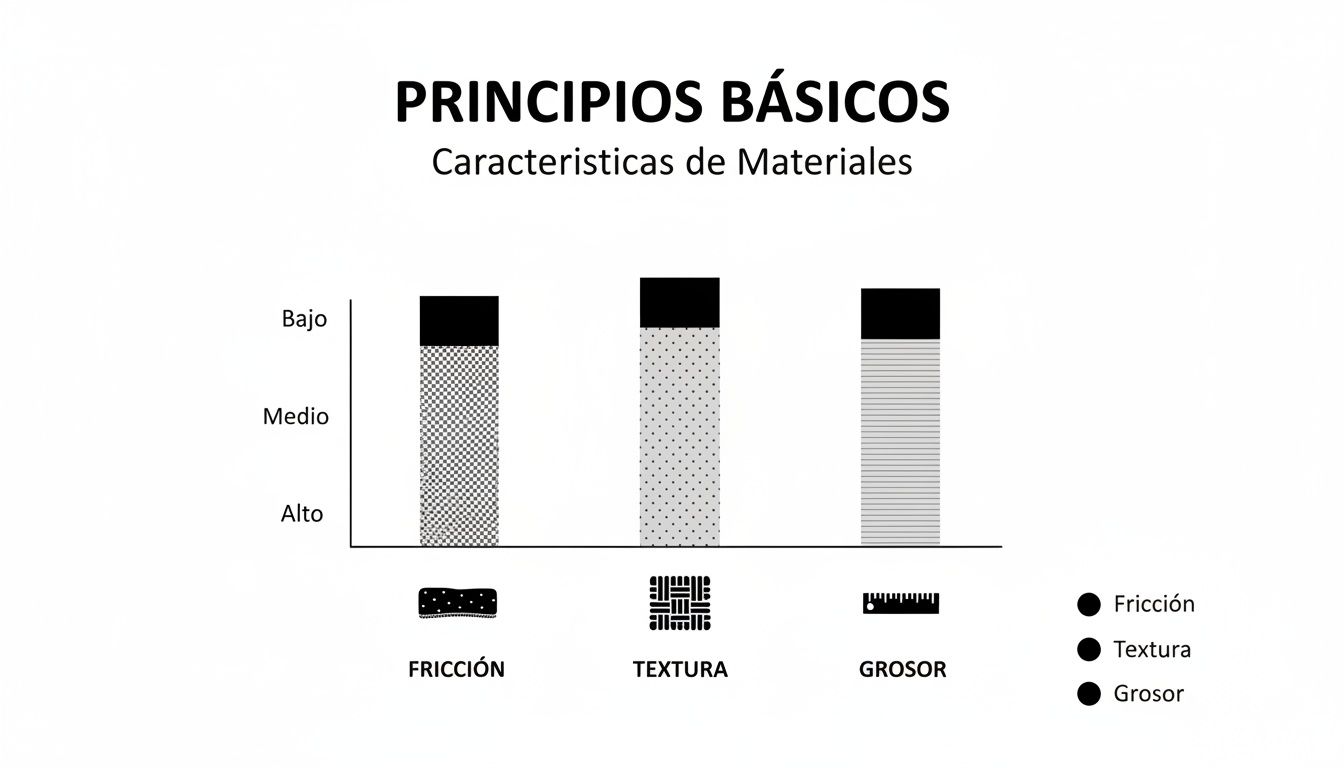
According to the chart, high friction enhances control, while thickness directly influences wrist comfort.
In Spain, textile and rubber mousepads range between €10 and €30, representing 60–70% of the online market. In contrast, premium options (aluminum, glass or RGB) are around €50 to €120 and account for only 10–15% of the offer. Discover more insights about prices in Spain in this source. Read more about mousepad sales
Check our gaming peripherals guide to complete your setup with compatible accessories.
Below, a clear comparison of advantages, disadvantages and average price.
Material and Price Comparison
| Material | Advantages | Disadvantages | Average Price |
|---|---|---|---|
| Fabric | soft grip and precise control | wear after intensive use | 10 € – 30 € |
| Rigid rubber | low friction and high durability | somewhat rigid feel | 12 € – 25 € |
| Aluminum | ultra-fast gliding | cold sensation to the touch | 40 € – 80 € |
| RGB/Glass | customizable lighting | high cost | 60 € – 120 € |
This table allows you to quickly assess which material fits your budget and gaming or work needs.
If you have a tight budget, basic fabric offers solid performance. For those seeking extra durability, rigid rubber is a smart choice.
The mid-range, such as aluminum, provides speed without breaking the bank. And if you want maximum style and features, RGB mousepads with wireless charging are the premium option.
Take advantage of seasonal sales to reduce your cost by up to 20%. And don’t forget to clean the surface regularly: a damp cloth and mild soap can extend your mousepad’s lifespan.
Small details, like a thickness of 4 mm, make a difference in comfort. Combine these recommendations with practical tests on your setup before buying and you’ll get the most out of every penny invested.
The size and shape of your mousepad make the difference between smooth gliding and small stumbles when moving the cursor. A surface that fits just right on your desk prevents bumps against edges; on the other hand, a larger piece gives you the freedom for long strokes without worrying about going out of bounds.
Compact models typically measure around 250 x 210 mm, perfect for carrying in your backpack or installing where space is lacking. On the other hand, medium mousepads of 350 x 300 mm offer that middle ground between portability and comfort.
When we go up to XL/XXL, we’re talking about surfaces of 900 x 400 mm (or more), capable of accommodating mouse and keyboard without overlaps or tensions.
In Spain, demand for XL and XXL mouse mats grows especially in summer and autumn, with search peaks of up to 35% in remote work and gaming. Discover more about this seasonal trend here.
“A large surface reduces fatigue and improves precision with every movement,” highlights an ergonomics expert.
The rectangular shape is the most traditional option: it fits any desk and facilitates toolbar placement. However, some designers have incorporated curved or rounded edges to add an aesthetic and practical touch.
There are also mouse mats that extend under the keyboard, creating a single base that protects your entire work area.
To get the format right:
| Format | Typical dimensions | Recommended use |
|---|---|---|
| Compact | 250 x 210 mm | Mobility and portability |
| Medium | 350 x 300 mm | Office and daily tasks |
| XL/XXL | ≥ 900 x 400 mm | Intense gaming and multitasking |
Many creators place the front edge of the mouse mat right at the desk edge: this way the wrist rests and sudden slips are avoided. An illustrator I know covered their entire work surface with an XL; the result was less tension when alternating fine details and quick movements.
With these clear criteria, you’ll find the perfect mouse mat for your setup. Start today and enjoy smooth and consistent control every day.
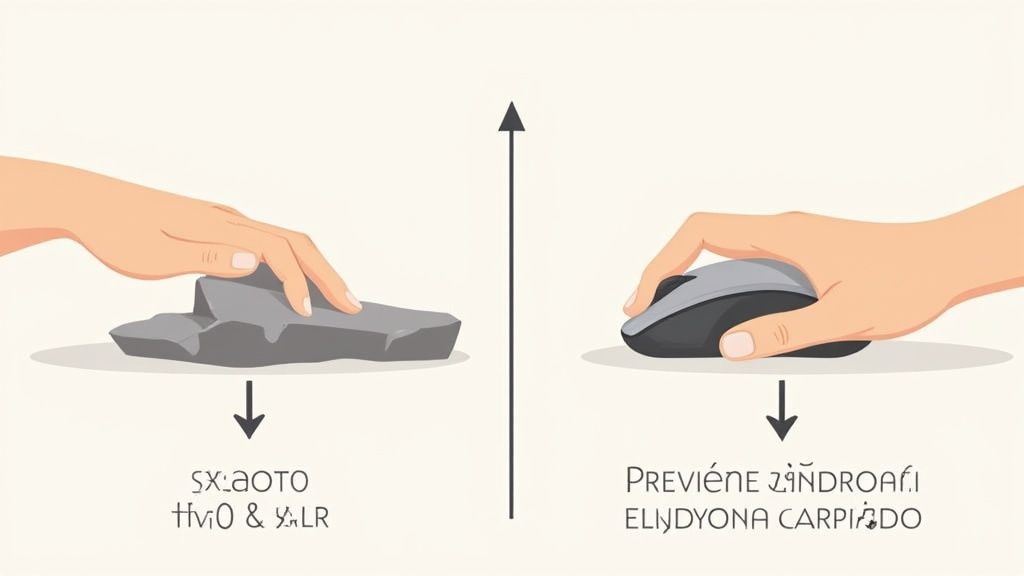
When you rest your wrist on a mouse mat with a wrist rest, the sensation resembles placing your hand on a firm pillow rather than a hard surface. That small difference relieves tension accumulated after hours of work or play.
By having a soft cushion, pressure is distributed evenly and avoids compression points that can lead to discomfort. This way, you reduce the risk of developing the dreaded carpal tunnel syndrome.
Additionally, wrist rests usually incorporate gel, viscoelastic foam, or non-slip silicone. These materials adapt to the contour of your wrist and return to their original shape after each use. Most users describe the experience as “resting on a solid cloud”.
“An ergonomic mouse mat improved my productivity and eliminated chronic discomfort in six weeks.”
Thanks to proper support, the hand and forearm maintain a more natural posture. Over time, this alignment prevents muscle fatigue and repetitive strain injuries.
Essentially, a padded wrist rest acts as a cushion against constant impacts. Imagine frequently hitting a hard surface: the impact is transmitted to your body. With gel or foam, that force is dispersed rather than concentrated at a single point.
Additionally, these supports keep the wrist slightly elevated, preventing tendon hyperextension. This way, your hand, wrist and forearm maintain a neutral alignment that promotes circulation and reduces tension.
In Spain, 28%–36% of users who switched to an ergonomic mouse pad perceived less discomfort after six weeks of use, and 35% of new models already integrate ergonomic design. Discover more insights about mousepad ergonomics
Practical research indicates that proper support can reduce wrist pain intensity by 50%. At the same time, tendon rest extends endurance during writing or gaming sessions.
Experts advise aligning the wrist rest with keyboard level to prevent the wrist from being too low or too high. The ideal is to maintain an angle close to 0° between hand and forearm.
Also, alternate work periods with simple exercises. For example, take 30-second breaks to close and open your hand.
With these habits you improve your posture, extend the life of the mouse pad and prevent premature deformation.
The simplest way to maintain firmness and bounce is to hand wash it with warm water and neutral soap. Avoid harsh products that could damage the gel or foam.
Air dry it, but without direct sun exposure. Similarly, check the non-slip base from time to time. A firm base ensures that the mouse pad stays in place just when you need it most.
Proper maintenance extends effectiveness and prevents premature deformation.
Following these guidelines, you’ll enjoy optimal support day after day, both in the office and in your most intense gaming sessions.
Before buying, clarify your main use and set a realistic budget.
Each type of user values different aspects: material, size and cost.
Below, we present four typical profiles with their approximate investment:
Selecting the correct profile can save up to 30 % in costs without sacrificing performance.
For small spaces, choose a compact model. If you have an ample setup, an XL mousepad offers maximum freedom of movement.
In gaming, smooth surfaces (aluminum or glass) reduce friction. In the office, soft fabrics provide more comfort and keep the sensor clean.
Basic care extends the life of your mousepad. This way you avoid the accumulation of dust and dead skin remains.
Avoid exposing it to direct sunlight and do not use harsh detergents.
You can also consult our gamer gifts guide to find complementary options.
Plan your purchase on Black Friday or January sales and get up to 20 % discount.
Basic fabric models can drop to 10 €–15 € on sale, while the premium option occasionally drops to 35 €.
Customizing logo or colors usually has a surcharge of 5 €–10 €, keeping the cost moderate.
In this section you will find clear answers to choose the perfect mousepad, whether for your games or your work day.
What is the difference between rigid and textile surfaces?
Rigid surfaces reduce friction to a minimum and tend to last longer.
Textile surfaces, on the other hand, add extra cushioning that softens every movement.
What are the most effective cleaning methods?
The most recommended approach is to wash by hand with lukewarm water and neutral soap.
Avoid any harsh detergents and let them air dry, away from direct sunlight.
Simple care extends the life of your mousepad.
What is the compatibility of gaming mousepads in office environments?
A model with low friction fits perfectly for office tasks.
The uniform texture helps the sensor register every stroke with precision.
Rubber ones offer exceptional durability and resist daily wear.
Aluminum or glass ones stand out for their fast gliding, although they require a bit more care.
What are the criteria for choosing optimal thickness?
A thickness of 3–4 mm is usually the best option: it combines comfort and stability.
If you want more cushioning, look for models of ≥ 6 mm, but keep in mind the slight loss of feel.
To finish, adjust your choice to the available space and your usage style.
Trying different materials in your setup is the best way to hit the mark.
How does mousepad size influence performance?
A large area gives you freedom for precise movements.
On smaller desks, a compact design helps you save space.
XL mousepads enhance stability with every swipe.
Can they be customized with geek designs?
Yes, many allow custom printing without losing performance.
A geek design adds personality and keeps performance intact.
Before using it, always check that the non-slip base is in optimal condition.
Shop at Tienda Camisetas Frikis
Hundreds of original designs waiting for you in the store.
Join the club and we’ll email your welcome coupon right away. Original anime, gaming and comic designs.