Anime & Manga21 min read
Differences between manga and anime: quick guide to choose your format
By
Published on 15 de Jun 2026
The main difference between manga and anime is as simple as it is profound: manga is Japanese comics, the original work on paper, while anime is its adaptation to animation. Although they share worlds and characters, the experience that each format offers you is radically different. Think of it as the difference between reading a Harry Potter book and watching its film adaptation; same magic, different spell.
Has it ever happened to you? You see an epic battle in Dragon Ball Z, you look for that same scene in the manga and you realize that the pace, the tension, is completely different. That sensation perfectly sums up the distinction between these two giants of Japanese pop culture.
It’s not just a matter of paper versus screen, but of narrative language, pace and pure artistic creation.
Although they often start from the same idea, like Izuku Midoriya’s adventures in My Hero Academia, manga and anime grow in separate ecosystems. Each one has its own DNA that engages fans for very different reasons, creating a duality that enriches the otaku universe tremendously.
Manga is the pure and unfiltered vision of the mangaka (its author). Sequential art, almost always in black and white, where you, as a reader, have total control of the time. You pause where you want, you speed up when the action grabs you. It’s like playing a turn-based RPG: you decide the next move.
On the other hand, anime transforms that static vision into a dynamic audiovisual spectacle. It adds movement, color and soundtracks that can be as iconic as the series itself. Pure real-time action.
So you can see these differences at a glance, here’s a visual summary that makes everything crystal clear.
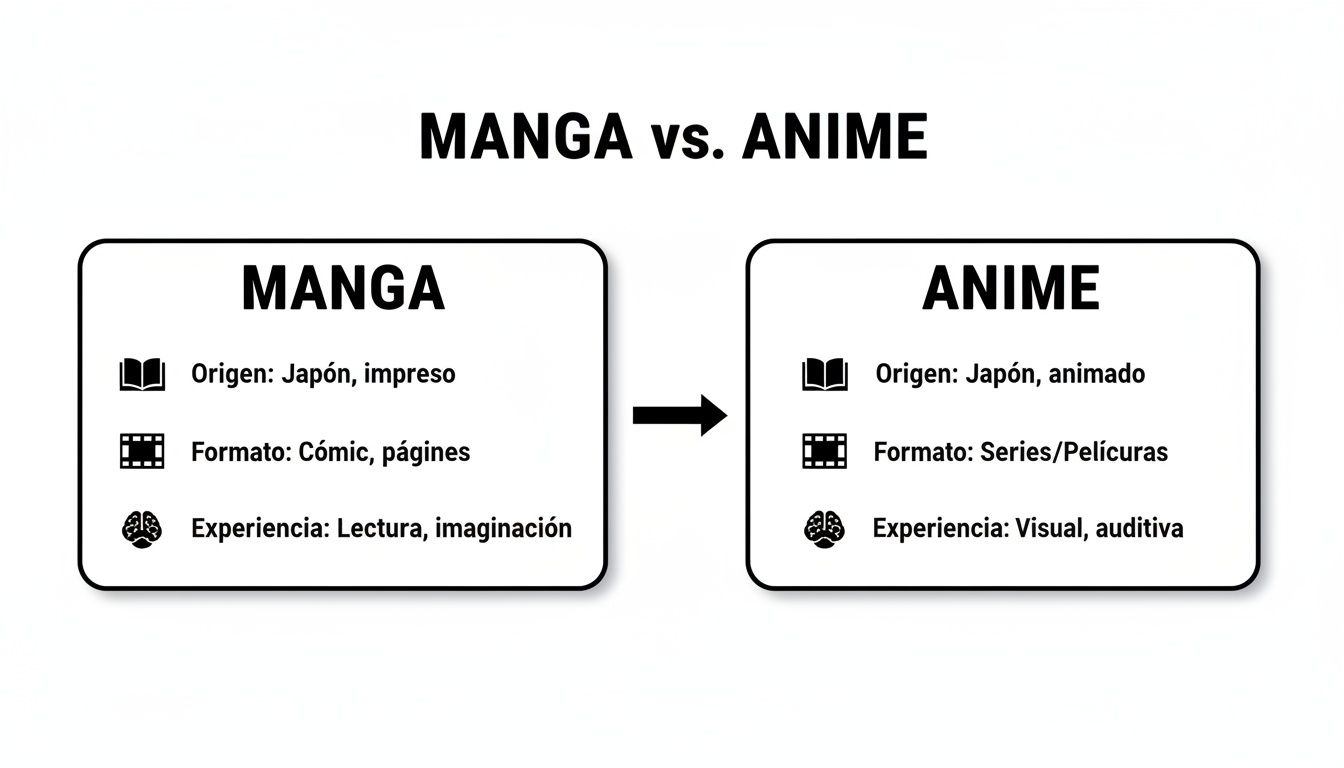
As the infographic shows, manga starts from the book and immerses you in a more cerebral and introspective experience. Anime, with its cinematic origin, bombards your senses with a much more dynamic experience.
In essence, manga allows you to direct your own film in your head, while anime invites you to sit back and enjoy a director’s vision. Neither is better than the other, they are simply different ways of telling the same story.
This duality is precisely what drives us fans to collect manga volumes while eagerly waiting for the next episode on streaming. And it’s the reason why we proudly wear geek t-shirts that are a standard of our favorite saga, regardless of the format.
For those in a hurry, this table summarizes the key differences so you can understand them at a glance.
| Criteria | Manga (the original work) | Anime (the adaptation) |
|---|---|---|
| Format | Printed comics, almost always in black and white. | Animated series or film, in full color. |
| Pace | You set it. It allows you to stop at each detail. | Defined by the director, with a pace of about 20 minutes per episode. |
| Content | The canonical story, with no filler and more depth. | Can include filler episodes, censorship or plot changes. |
| Experience | Immersion through sequential art and your imagination. | Audiovisual immersion with music, voices and movement. |
As you can see, even though the story is the same, the way you experience it is a whole different world. Each format has its magic and its moment.
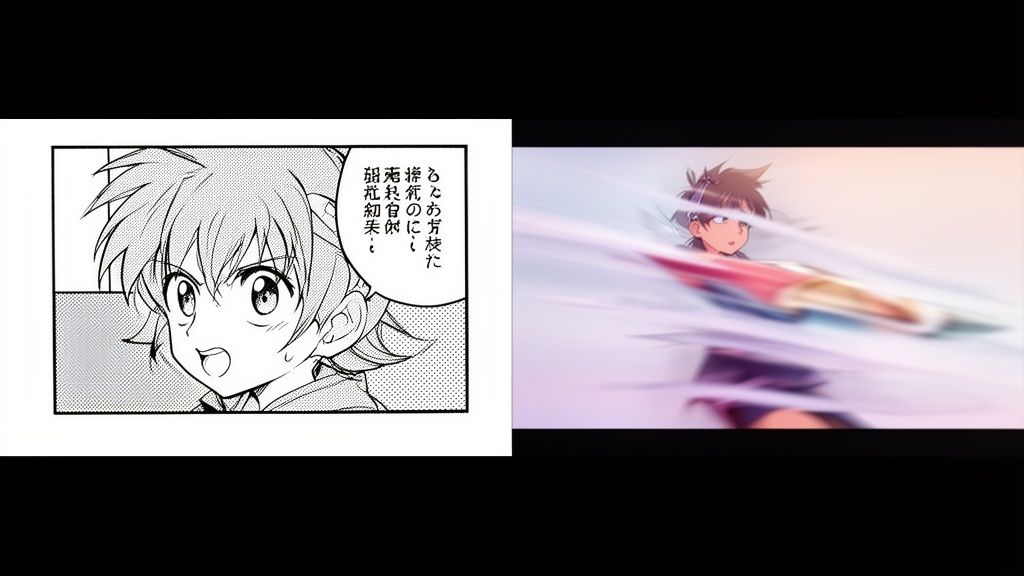
The journey a story makes from comic panels to animation is one of the differences between manga and anime that’s most mind-blowing out there. It’s almost like watching a character’s evolution in an RPG: it starts as an idea and ends up becoming a legend. It all starts in the head of the mangaka, who is a kind of creator god, director, screenwriter and artist of their own work.
Authors like Eiichiro Oda, the genius behind One Piece, have almost millimetric control over every line of dialogue, every panel and every plot twist. They work with brutal deadlines, whether weekly or monthly, for legendary magazines like Shōnen Jump. With their art, they build the world and characters from scratch, creating the original vision, the source from which everything else will drink.
This is when the true magic (and madness) of the process begins: when an animation studio decides to adapt that story. And trust me, adapting is much more than “copy and paste in motion”.
When a top-tier studio like MAPPA (Jujutsu Kaisen, Chainsaw Man) or Ufotable (Demon Slayer) gets involved, the project goes to the next level. If the manga is the sheet music, the animation studio is the orchestra that decides with what instruments and with what intensity the melody will sound.
In this phase, key decisions are made that can take an adaptation to stardom or sink it into oblivion. Among them are:
This is where the soul of anime is forged. A studio can be super faithful to the manga, almost tracing each panel, or it can take creative liberties that turn it into something completely new.
Not all adaptations follow the manga to the letter. Sometimes, deviations are a pure necessity, like when the anime catches up to the manga and studios have to invent filler arcs to give the author time to advance. Other times, they are completely intentional artistic decisions.
A textbook case study is the 2003 first adaptation of Fullmetal Alchemist. The anime caught up to the manga very quickly, and the Bones studio, with the approval of author Hiromu Arakawa, pulled a completely original ending out of the manga. Years later, Fullmetal Alchemist: Brotherhood was released, a new version that did faithfully follow the manga’s story. The result: two versions of the same adventure, each with its own charm, for the enjoyment of fans.
This duality demonstrates that the differences between manga and anime are not only in the medium, but in the very heart of the creative process. One is the vision of a single author; the other, the reinterpretation of an entire team of artists that transforms that vision into a global spectacle.

One of the differences between manga and anime that generates the most debate at any geek gathering is how each medium handles the story. Because no, the narrative doesn’t feel the same on paper as it does on screen, and that adaptation completely changes the experience.
Reading a manga is like playing an open-world RPG, like The Witcher 3 or Skyrim. You set the pace. You can spend ten minutes blown away by a single panel, analyzing every stroke by Kentaro Miura in Berserk, or you can devour an entire arc in an afternoon if the story has you hooked. You have the control.
The anime, on the other hand, puts you on a roller coaster at a fixed speed. Each episode lasts about 20 minutes and needs to maintain a constant pace, designed for television, so the audience comes back week after week. And from that necessity comes one of the most hated and controversial concepts in the scene: filler.
Filler, as it’s known in English, refers to those episodes or story arcs that don’t appear in the original manga. They’re created for a very simple reason: to give the mangaka time to advance the story and prevent the anime from catching up. Long-running series like Naruto or Bleach are famous for their filler sagas, which often feel like side missions that don’t contribute anything to the main plot of the game.
Although every now and then filler gives us some memorable moments, like the legendary episode where Team 7 tries to see Kakashi’s face, most of the time it only manages to break the tension and dilute the pace of the original story.
The manga gives you the pure story, the canonical lore without additives. The anime, on the other hand, often has to invent content to fit its production schedule, and that can destroy the impact of the main plot.
But filler isn’t the only modification. Many times, the anime changes the original script for different reasons. One of the most common is censorship. The extremely violent or graphic content of a manga is usually softened to be able to air on television and reach a wider audience, something that’s very noticeable in adaptations of darker works.
And sometimes the alterations are much more radical. There are animation studios that decide to take a completely different path, creating endings that have nothing to do with the original material. A textbook case is Akame ga Kill!, whose anime deviated from the manga halfway through and created a completely different and much more tragic outcome for its characters.
In summary, while manga offers you the purest experience faithful to the author’s vision, anime reinterprets that vision, adapting it to the demands and constraints of the television format. And this is one of the key differences between manga and anime that every fan should know before choosing where to start a new adventure.
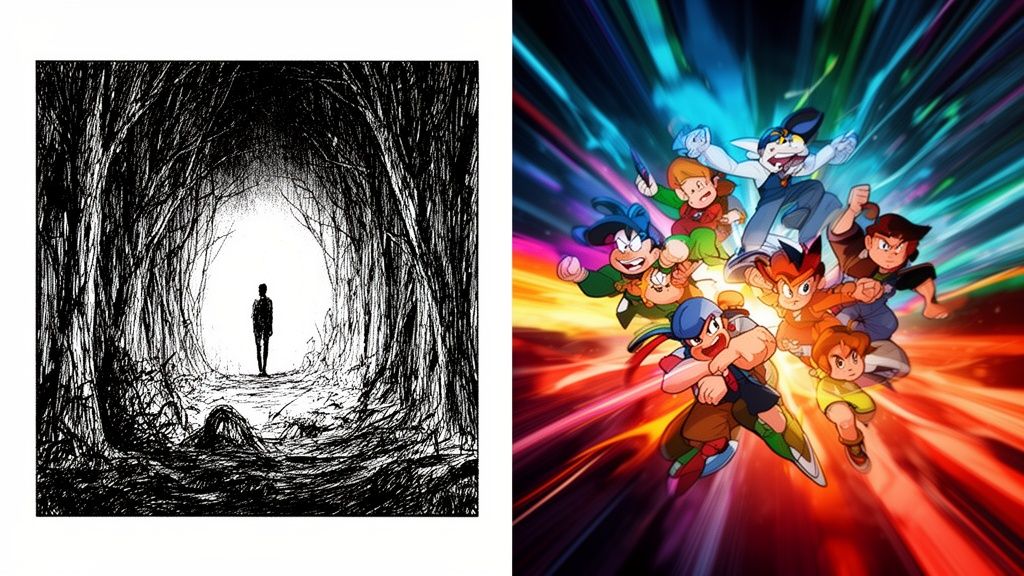
If we set aside the pace and story, the big gap between manga and anime is in their visual language. The way a manga tells you something with a static drawing is an art in itself, while anime reinterprets it with movement, color and sound. It’s as if they spoke two different languages to tell the same story.
Manga is the king of black and white. And what might seem like a limitation is, in reality, its greatest superpower. Mangakas are true masters of contrast, shading and the use of patterns to create textures and atmospheres that color sometimes simply dilutes. The design of the panels and kinetic lines are their tools to convey movement and emotion, making everything explode inside your head.
Psychological terror, for example, finds its best ally in the manga page. The work of Junji Ito, with those panels that force you to pause to absorb the horror in silence, is the perfect proof. The tension builds in that pause, in that macabre detail that your eye cannot escape. It’s an experience that anime’s movement sometimes accelerates too much.
If manga whispers to your imagination, anime shouts directly at your senses. Its toolbox is completely different, drawing directly from the language of cinema and video games.
Anime transforms the strokes into a spectacle of color, light and movement. You only have to think of the incredible choreography of the battles in Jujutsu Kaisen or the pure adrenaline of a match in Haikyuu!!. Those sequences are an audiovisual feast, where fluid animation and an epic soundtrack take the emotion to another level.
Manga gives you the blueprints of an incredible machine for you to build it in your mind. Anime delivers it to you already assembled, at full speed and with the speakers turned up.
Another one of the differences between manga and anime that’s most interesting is seeing how characters evolve when they jump to the screen. The original design of the mangaka is almost always simplified or adapted so that the animation process is feasible. Keep in mind that you have to draw that character thousands of times and from every possible angle.
In the end, each format plays with its own weapons to have an impact. Manga captures you with art full of details and a rhythm that you set, while anime immerses you fully in a vibrant sensory experience, more like watching a Marvel movie or being blown away by the final cutscene of a Final Fantasy.
It sounds crazy, but it’s true: the massive arrival of anime on platforms like Netflix, Crunchyroll and Disney+ has caused a completely unexpected effect. Instead of eating up the physical manga market, it has catapulted it to record figures. Anime has become a kind of giant trailer, a global showcase that sparks the flame in millions of viewers.
Sure, this scene sounds familiar to you: you discover an anime like Demon Slayer or Chainsaw Man, the animation blows your mind, the story hooks you… and when the season ends, you need to know how it continues. The solution is simple: run to the nearest bookstore to grab the manga volumes and devour the story directly from the original source, without waiting.
This phenomenon has turned the publishing market in Spain upside down. Manga is no longer a niche, it’s a fundamental pillar of bookstores, with growth that defies all logic in the digital age. And the fanaticism that drives this trend is one of the clearest differences between manga and anime that exists in how they are consumed.
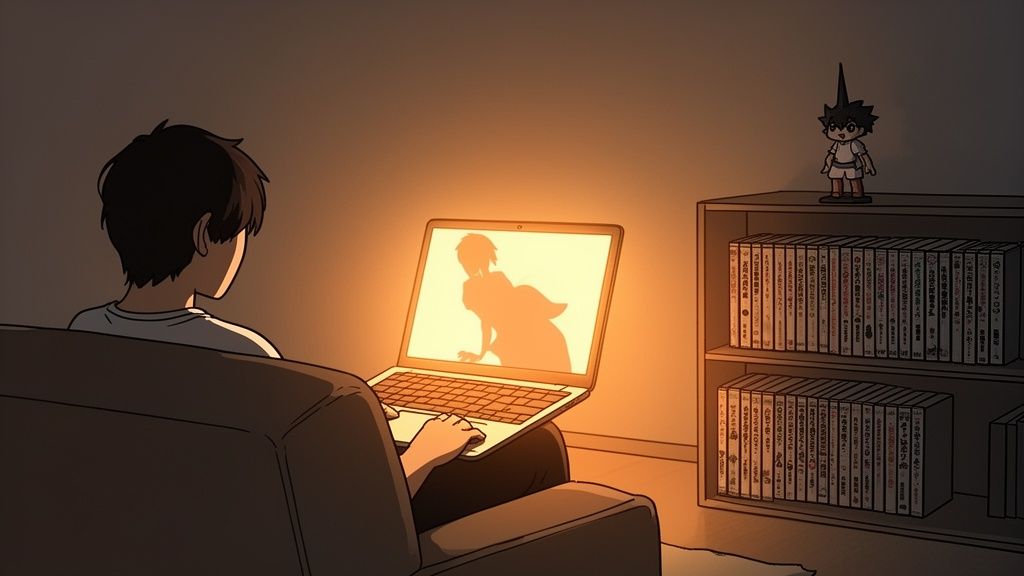
Streaming gives you immediacy, but it’s a consumption that feels ephemeral, fleeting. Manga, however, appeals to something much deeper: the pleasure of collecting, that satisfaction of having the original work on your shelf. It’s a feeling very similar to what drives a gamer to collect figures or a film buff to hunt for special Blu-ray editions.
Manga is an object of worship. It’s not just the story, it’s a trophy that proves your connection to that universe, a piece of the mangaka’s art that you can touch and feel is yours.
This passion for the physical is seen in the numbers. In Spain, manga sales have quadrupled since 2021, reaching the incredible figure of 1,700 new releases in 2023 alone, largely thanks to this anime call effect.
But collecting doesn’t stop at just the volumes. This same impulse spreads to other products that allow us to wear our passion proudly. From a t-shirt that shouts what your favorite saga is to detailed figures of your characters, like the popular League of Legends Funko Pops, it all forms part of the same ritual: making physical and visible the love we feel for a story.
The eternal otaku question: manga or anime? Where the heck do I start? Think of it like choosing between a classic turn-based JRPG or a frantic hack and slash full of explosions. They’re two very different paths to experience the same story, and the right answer depends on the experience you’re looking for at that moment.
If you’re someone who seeks the pure version, the canonical story without filters or filler, the choice is easy: manga. It’s the only way to truly immerse yourself in the philosophical density of a work like Berserk without missing a single piece of the puzzle, controlling the pace yourself and savoring each panel as the author drew it.
Now, if what your body is asking for is a shot of audiovisual adrenaline, with action scenes that leave you breathless and a soundtrack that gets stuck in your head for weeks, then anime is your battlefield. It’s the ultimate way to feel the tension of Attack on Titan with its thunderous music or to dive headfirst into a new franchise in a spectacular and direct way.
Opting for manga is like choosing the main campaign of a video game on its most authentic difficulty. You get the story just as its creator conceived it, with all character development intact and without those filler arcs that sometimes pull you out of the plot. It’s the perfect option if you value depth and like to be in control.
Anime is the final cinematic experience, the moment when everything explodes on screen in full color. If what you’re looking for is vibrant action, a feast for the senses, and a more passive way to consume the story, animation delivers it in spades. It’s ideal for getting hooked on a saga quickly and visually impactfully, and also a fantastic gateway to discovering the different types of anime that exist.
The final decision isn’t about which format is superior, because there isn’t one. They’re complementary experiences. The true fan knows that to have a complete vision of a work, the ideal is to explore both worlds and enjoy the best of each.
Consumption trends make it clear: printed manga continues to dominate for its value as a collectible, projecting itself as the fastest-growing segment in Europe until 2032. Meanwhile, anime reigns unchallenged in digital consumption and streaming platforms. Two ways to enjoy, two giant markets that coexist perfectly.
Let’s clear up those questions that always come up when we talk about manga and anime. Here you have direct, straightforward answers, whether you’re just getting into this world or you’ve been collecting volumes and subscribed to Crunchyroll for years.
The eternal question. The honest answer is: it depends on what you’re looking for and the work itself.
With adaptations that are a carbon copy of the manga, like what happens with Jujutsu Kaisen, you can start wherever you want. The experience is going to be practically the same. However, there are cases like Tokyo Ghoul where reading the manga first isn’t an option, it’s a requirement. The anime skipped story arcs so important that, without the manga, you miss half the story.
This usually happens for two main reasons. The first is purely practical: anime moves faster than manga, and to avoid catching up to the author, studios add “filler” arcs. These are stories that don’t affect the main plot and serve to give time for more manga chapters to be published.
The second reason is a creative decision. Sometimes, a studio decides to take a different path, as happened with the first adaptation of Fullmetal Alchemist. They created a completely original ending, giving rise to an alternative version of the story that many fans love.
An original anime is a work created directly for the screen, without a previous manga to serve as its script. Gems like Cowboy Bebop or Code Geass were born this way, offering complete and polished stories that are 100% canonical in their animated format.
Both are giants, but they play in different leagues. Anime is the absolute king of digital consumption thanks to streaming platforms like Netflix or Crunchyroll, which have put it within reach of a click.
On the other hand, if we’re talking about physical sales, manga wins by a landslide. Collecting, the pleasure of having the original work on the shelf, and the quality of editions drive a massive market. The impact is so huge that the premiere of an anime like Demon Slayer caused its manga sales to skyrocket in Spain, attracting 58% more new readers. If you’re interested in the topic, you can see more data in this analysis of the Spanish market.
At Geek T-Shirt Store, we love both the art of manga and the spectacle of anime. We want you to wear your passion with pride, which is why we create designs that connect with your favorite sagas. Check out our online store and find that t-shirt that screams to the world which side you’re on (or if, like us, you’re on both).
Hundreds of original designs waiting for you in the store.
Join the club and we’ll email your welcome coupon right away. Original anime, gaming and comic designs.